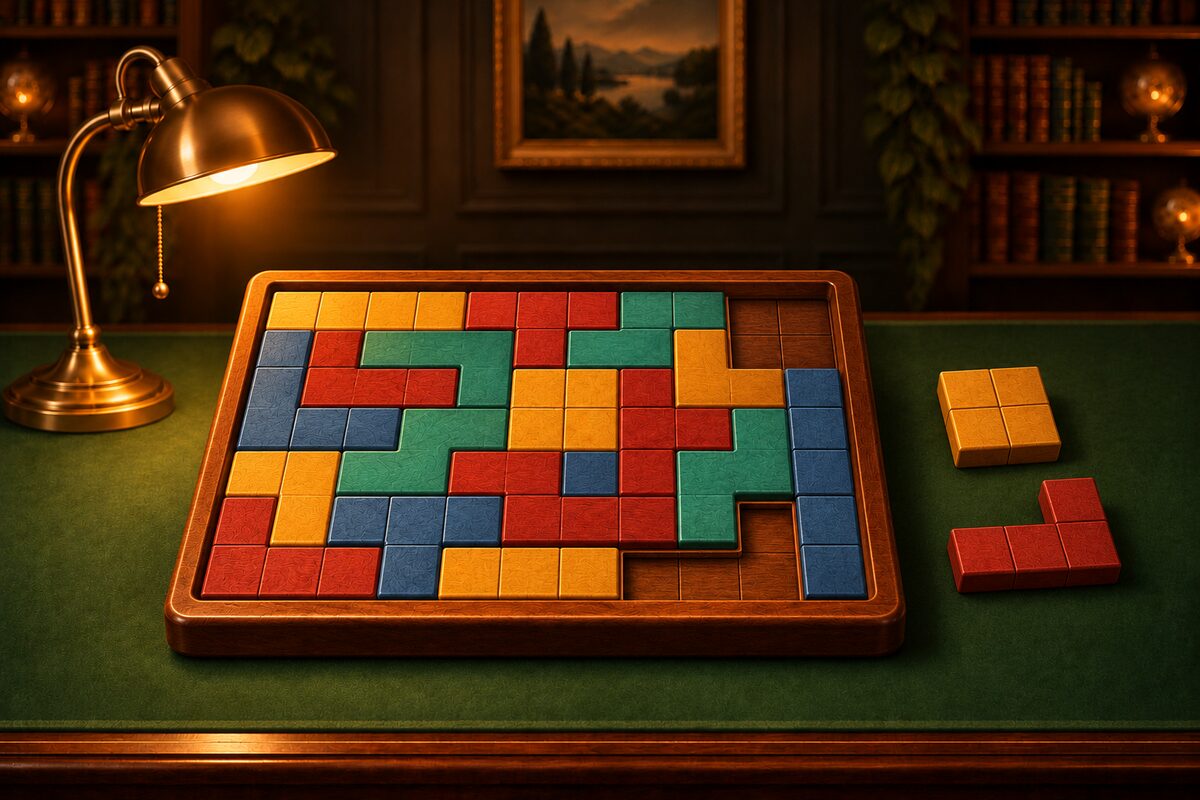
A common tip for block puzzles is to “place the big pieces first.” Is that really true? I counted with a computer to find out.
In an Empty Frame, It Barely Matters
First, in an empty 6×6 frame, I counted how many ways there are to place a single piece. Every rotation and every position is counted (pieces are not flipped over).
| Piece | Average placements |
|---|---|
| 3 cells | 74.0 |
| 4 cells | 54.4 |
| 5 cells | 56.9 |
The 3-cell piece has the most placements, but the 4-cell and 5-cell pieces came out almost the same. A 5-cell piece has fewer positions, but it has more orientations. In an empty frame, big pieces are not especially hard to place.
Once Half Is Filled, the Gap Widens
Next, I prepared 2,000 6×6 puzzles built the same way as in the app, and set up mid-game positions with half of the solution pieces already placed. For each remaining piece, I counted the ways it fits into the empty spots.
| Piece | Average placements | 3 or fewer |
|---|---|---|
| 3 cells | 21.1 | 0% |
| 4 cells | 12.3 | 4.4% |
| 5 cells | 11.1 | 11.5% |
Among 3-cell pieces, none had 3 or fewer placements, but among 5-cell pieces, more than 10% did. In other words, if you save the big pieces for late in the game, they may have almost no place to go.
Small Pieces Are for Fine-Tuning
As the game goes on, the gaps get smaller and more awkward. Small pieces are the ones that fit into them easily.
In the example above, a 3-cell L shape fit perfectly into the last three cells at the top right. If you place the big pieces first and keep the small ones for adjusting the last gaps, it is easier to fill the frame all the way.
But Corners and Dents Come First
Placing big pieces first is only a rule of thumb. If there is a spot that only a few pieces can fill, such as a corner or a dent, it is safer to settle that spot first (How to Solve Block Puzzles).
If you ask yourself, “Can I put a big piece into a hard-to-fill spot?” you can use both tips at once.