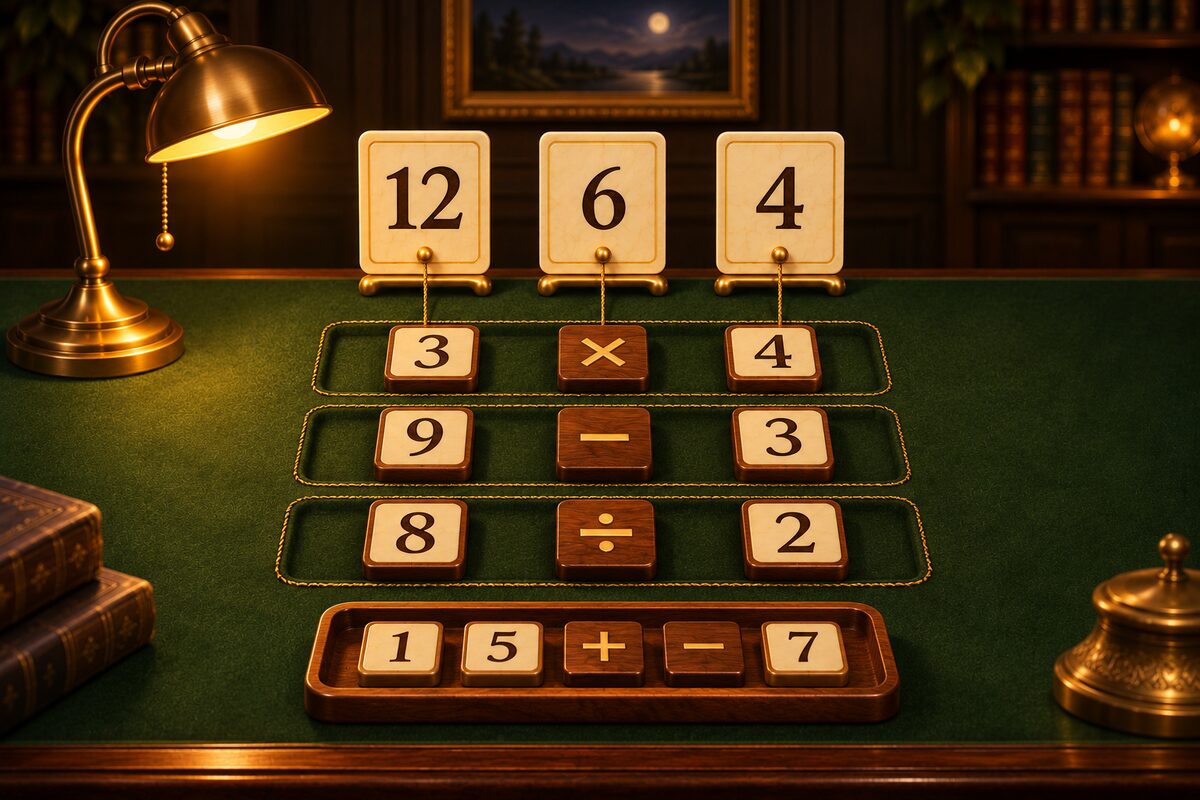
In Japan, many kids do an independent research project (jiyu kenkyu) as summer homework for school. If you can’t decide on a topic, how about a math puzzle? You can start with just paper and a pen, and you get to experience the flow of research firsthand: “list everything,” “count,” and “find patterns.” Here are some topics using the math puzzle Tsumezan.
Tsumezan Rules (a Quick Review)
You make the goal number with an equation that uses every number and sign tile exactly once. There are no parentheses, and × and ÷ come before + and −. ÷ only works when it divides evenly, and nothing may go below zero, along the way or at the end. For details, see How to Play Tsumezan.
Topic 1: List Every Arrangement and Count the Answers (Upper Elementary and Up)
Pick one set of tiles with 3 numbers and 2 signs, and write out every arrangement. There are 6 ways to order the numbers and 2 ways to order the signs, so 12 in all.
Here’s what we found with the numbers 4, 6, 8 and the signs + and −:
| Value | Example equations | Number of answers |
|---|---|---|
| 2 | 4 + 6 − 8 | 1 |
| 6 | 4 + 8 − 6, 8 − 6 + 4 | 2 |
| 10 | 6 + 8 − 4, 6 − 4 + 8, 8 − 4 + 6 | 3 |
| Not allowed | 3 equations, such as 4 − 6 + 8 | 0 |
Equations that only swap the order of addition, like 4 + 6 and 6 + 4, are counted as the same answer. There’s only one answer when the goal is 2. So you can see that the only goal that makes a “good puzzle” with these tiles is 2.
Example write-up: Try several sets and make a table of “how many goals make good puzzles when you change the tiles.”
Topic 2: Subtraction and the Number of Answers
Looking at the table in Topic 1, the goal with one answer came from “the equation that subtracts the biggest number, 8.” Equations that subtract a number smaller than 8 can be rearranged into other answers.
Hypothesis: “Equations that subtract the biggest number tend to have only one answer.” Test it with all kinds of tiles to see whether the hypothesis holds and whether there are exceptions. If you find a pattern and can explain why, that’s a great project.
Topic 3: How Many More Good Puzzles Do You Get by Changing the Signs?
Counting puzzles with 3 numbers and 1 goal that have exactly one answer gives these results (counted exhaustively by computer):
| Signs used | Puzzles with one answer |
|---|---|
| + and − only | 255 |
| +, −, × | 1,000 |
| +, −, ×, ÷ | 1,274 |
Adding × almost quadruples the count. Try explaining in your own words why × makes such a big difference.
Topic 4: Count Puzzles with Combinatorics (Middle School)
How many sets of 3 numbers and 2 signs (tile sets) there are can be counted with combinations with repetition.
- Number sets: choose 3 from 1 to 9, where the same number can be chosen any number of times → 165
- Sign sets: choose 2 from + − × ÷ (the same sign is OK) → 10
- Tile sets: 165 × 10 = 1,650
Of these, 1,956 puzzles have an answer that follows the rules, and 1,274 have exactly one answer. For the counts when there are more numbers or goals, see How Many Puzzles Can Be Made?. Checking the range you can count by hand and comparing it with the computer’s results also makes a good project.
Tips for Writing It Up
- Motivation: Why you chose this topic.
- Hypothesis: Before you investigate, write down what you expect.
- Method: The tile sets you wrote out and how you counted.
- Results: Put them in tables or graphs.
- What you learned: Compare with your hypothesis, and describe the patterns and why they happen.
- What you’d like to explore next: Adding signs, using two-digit numbers, and so on.
For ideas for the last “next” step, you can use the thinking in Extending the Tsumezan Rules. To make your own puzzles, see Make Your Own Puzzles.