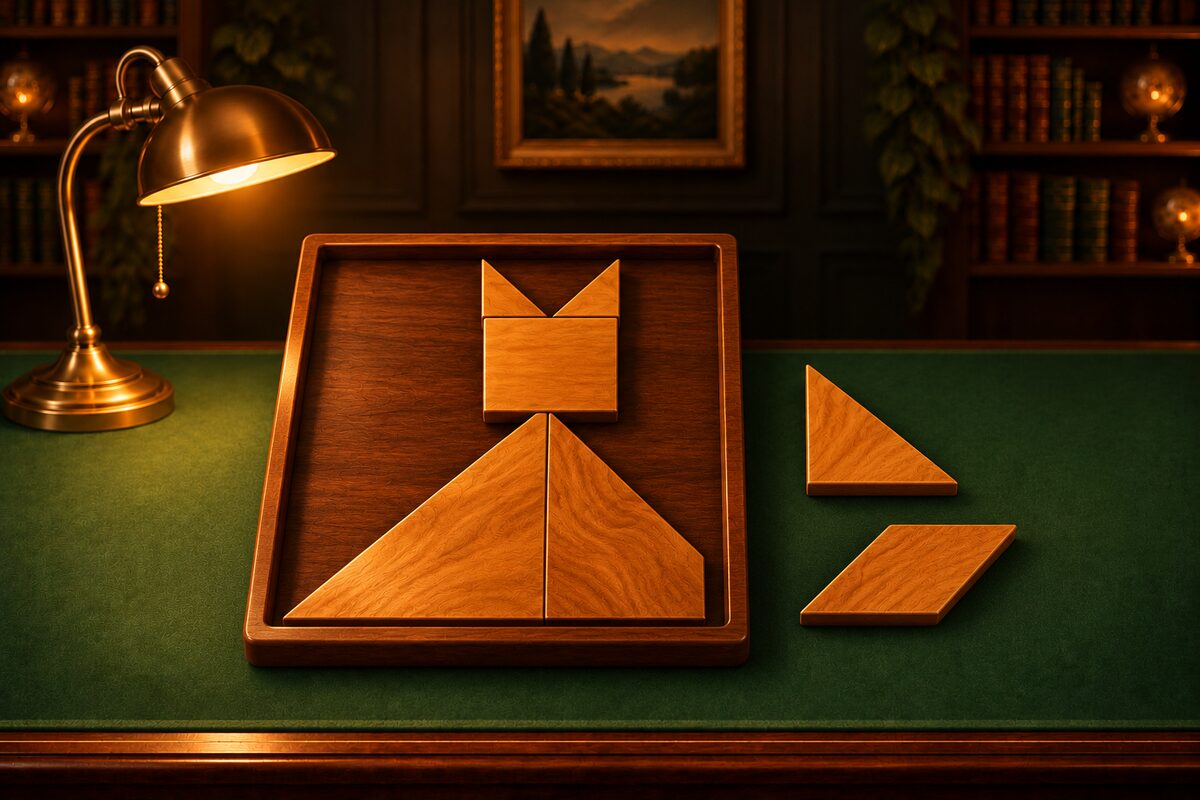
Tangram is a puzzle that has been played around the world for more than 200 years. However, exactly when and by whom it was invented is not clear. Here we separate what is known from what is not.
Born in China
Tangram is thought to have been born in China. In China it is called “qiqiaoban” (meaning “seven boards of skill”), and books collecting puzzle shapes are said to have been published there by the late 1700s or early 1800s.
Spreading Worldwide in the 1800s
In the early 1800s, tangram is said to have traveled from China to Europe and America and become a huge craze. Puzzle books were published in many countries, and many people played by arranging the pieces.
The English name “tangram” is also thought to have come into use around this time. Where the name comes from is not clear.
The “4,000-Year History” Is a Made-Up Tale
Stories sometimes say that tangram has existed for 4,000 years, or that a god named Tan created it. These are said to come from a made-up tale that the American puzzle writer Sam Loyd wrote as a joke in a book in the early 1900s. Today, it is believed that no such ancient records exist.
Japan’s Wisdom Plates
In Japan, during the Edo period, a very similar puzzle called Sei Shōnagon’s Wisdom Plates was known. It also uses a square cut into seven boards, but it is cut differently from tangram (What Are Sei Shōnagon’s Wisdom Plates?).
On to Mathematical Research
Tangram has also been studied by mathematicians. In 1942, two mathematicians are said to have proved that only 13 shapes with no dents (convex polygons) can be made with the seven pieces (13 Convex Polygons You Can Make with the Seven Tangram Pieces).
Many Relatives
There are many other puzzles like tangram, where you arrange pieces of set shapes to make a target shape.
- Sei Shōnagon’s Wisdom Plates: Seven boards handed down in Japan.
- Wisdom plates with other shapes: Versions with a different outer shape have also been made, such as boards cut from a circle, an egg, or a heart.
- Polygrams: Puzzles where you make shapes with pieces built from the triangles of a grid. The Rectangles and Silhouettes modes in the Tangram app belong to this family (What Is a Polygram?).
Tangram Today
Today, tangram is played in many forms, including wooden and plastic sets, ones made from paper, and smartphone apps. It is also sometimes used in math classes as a teaching tool for shapes (Math and Tangrams).