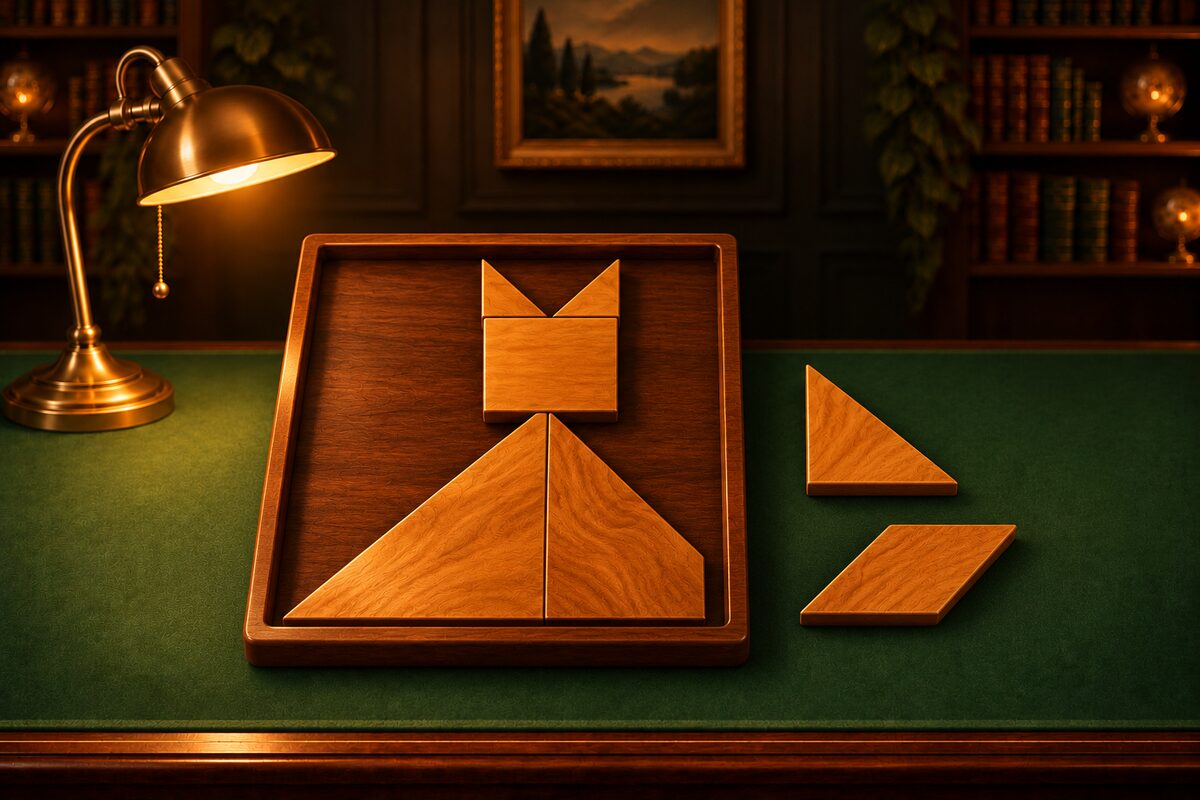
”Sei Shōnagon’s Wisdom Plates” is a board puzzle handed down in Japan. A square board is cut into seven pieces, and you arrange the boards to make all kinds of shapes. It is played in much the same way as tangram.
When Is It From?
A book with this name is said to have been published in 1742 (Kanpō 2), in the middle of the Edo period. The book is said to have contained many puzzle shapes to make by arranging the boards.
How It Differs from Tangram
Both are “a square cut into seven boards,” but they are cut differently. So the piece shapes, and the shapes that are easy to make, are different too.
The seven tangram pieces are shown below. Sei Shōnagon’s Wisdom Plates divides the square along different lines.
Tangram is said to have been born in China and to have spread around the world in the 1800s. Sei Shōnagon’s Wisdom Plates is thought to have been a separate puzzle known in Japan. The relationship between the two puzzles is not clear.
The Name and Sei Shōnagon
Sei Shōnagon was the author of The Pillow Book in the Heian period. However, there is no reliable record that Sei Shōnagon made this puzzle. It is thought that the name borrowed hers, since she was known as a clever person, to mean “boards that use your wisdom.”
How It Is Played Today
Sei Shōnagon’s Wisdom Plates is still sold today as a wooden puzzle and used as a teaching tool in math. Just like tangram, you play it like this:
- Look at the silhouette of the puzzle shape.
- Use all seven boards, arranged without overlapping, to make the same shape.
If you have both, there is also the fun of making the same shape with each of the two puzzles and comparing them.
The origin and spread of tangram are covered in The History of Tangram.