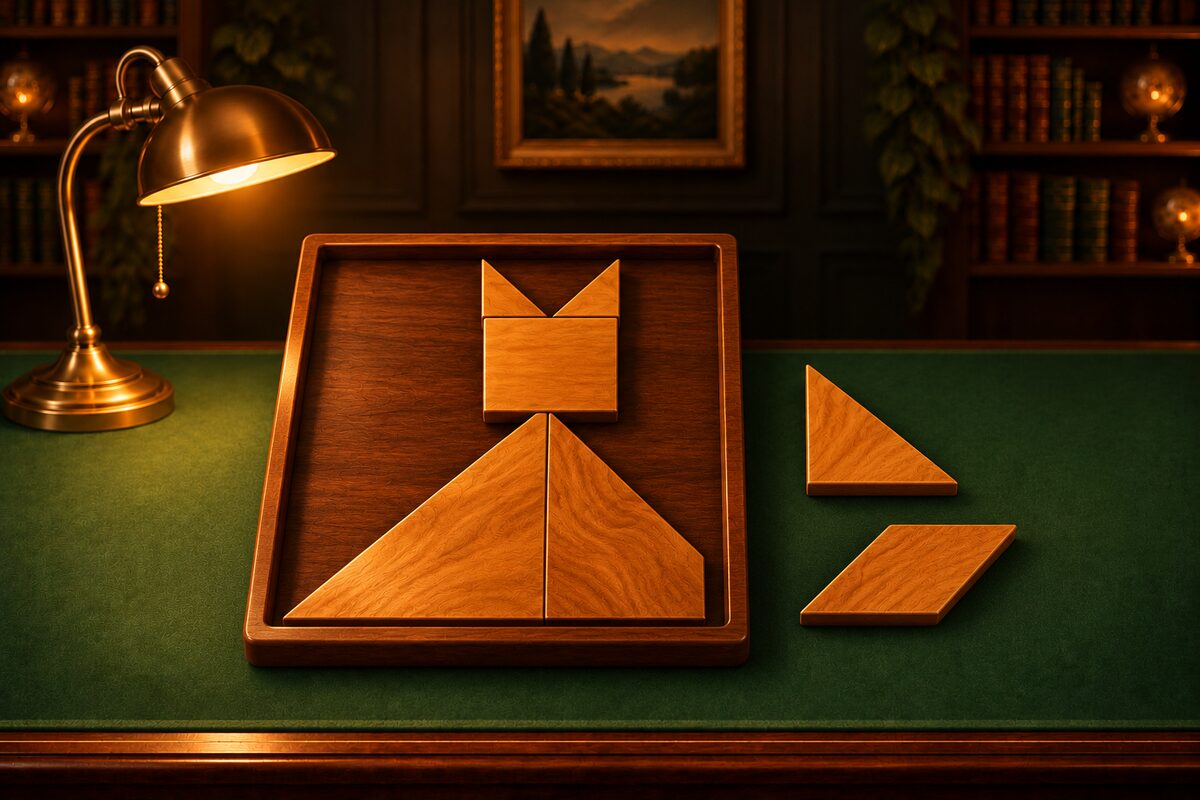
In the Rectangles and Silhouettes modes of the Tangram app, you play not with the classic seven pieces but with pieces whose shapes change with every puzzle. This article explains what shapes these pieces take.
Shapes Built from Grid Triangles
Each piece is built from triangles (fragments) made by splitting a grid square in two along a diagonal. Which squares are split, and in which direction the diagonal goes, changes with every puzzle.
That is why the sides of the pieces run only vertically, horizontally, or at 45° diagonals. The classic seven tangram pieces can also be placed on the same kind of grid. Here, we call puzzles made by combining grid triangles into shapes “polygrams.”
The figure below is an example at about the size of ★2 of Rectangles (4 pieces). A rectangle 3 squares wide and 2 squares tall is cut into 4 pieces.
The top left is a triangle, the middle two are trapezoids, and the bottom right is a square.
Rules for the Pieces
The pieces in the app follow these rules.
- Only shapes with no dents (convex polygons). You get triangles, quadrilaterals, pentagons, hexagons, and so on.
- Size from 1 square up to 4 squares (2 to 8 fragments).
- However you turn them, they fit within a width of 3 squares. Overly long, thin pieces do not appear.
Because only shapes with no dents are used, it is easier to think about which corner of a piece might fit where in the frame just by looking at its shape.
Rotate Only, No Flipping
The pieces in Rectangles and Silhouettes are only rotated 45° at a time by tapping, never flipped. The puzzles are made by using the cut-up shapes of the frame as the answer, so they can always be solved by rotating alone (How the Puzzles Are Made).
How It Differs from the Classic Tangram
- Piece shapes: The classic always has the same seven. Rectangles and Silhouettes change with every puzzle.
- Number of pieces: The classic has seven. Rectangles and Silhouettes have 3 at ★1 up to 7 at ★5.
- Flipping: In the classic, only the parallelogram can be flipped. In Rectangles and Silhouettes, you do not flip.
The classic seven pieces use the traditional shapes as they are. A polygram is another kind of tangram, one that starts from working out the piece shapes every time. The differences between the three modes are summarized in The Three Modes Compared.