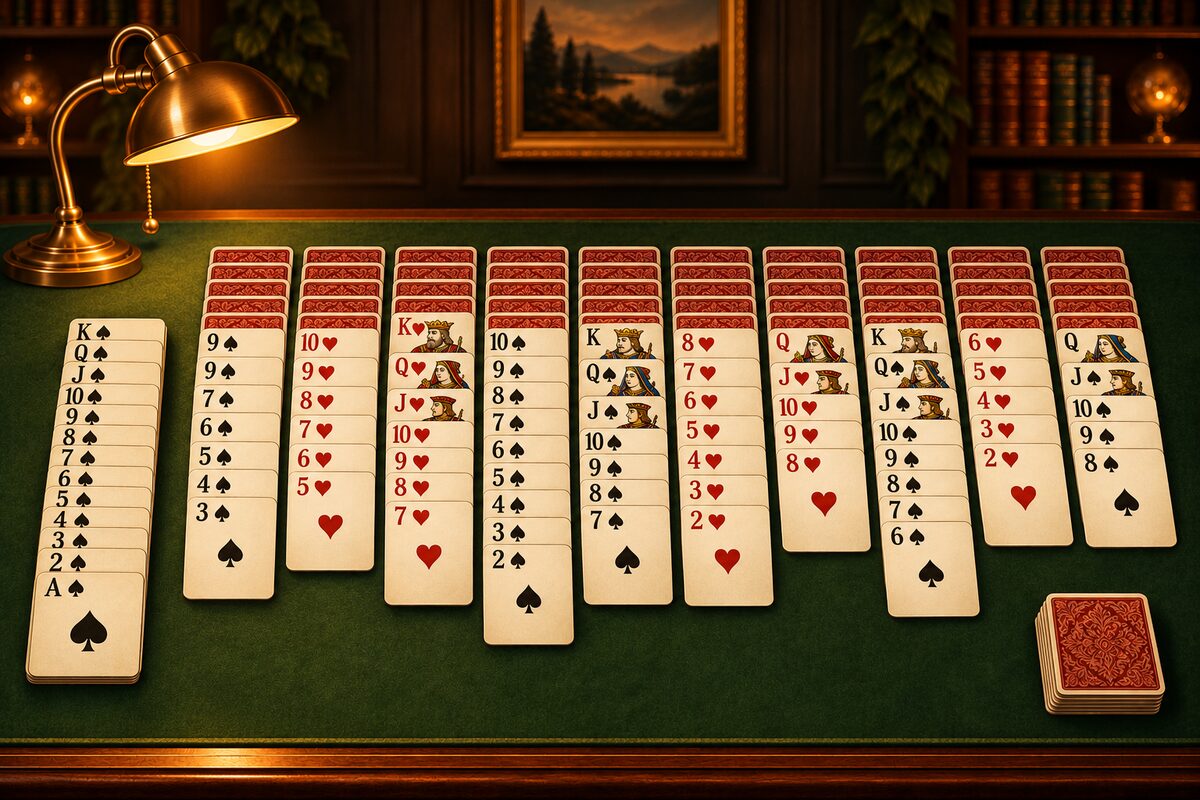
Spider, Solitaire (Klondike) and FreeCell are all familiar solo card games that came with Windows. They look similar, but the rules differ a little. Here we compare the three games.
Cards and layout
| Game | Cards | Columns |
|---|---|---|
| Klondike | 52 | 7 |
| FreeCell | 52 | 8 |
| Spider | 104 | 10 |
- Klondike: 28 cards are dealt into 7 columns, 1, 2, … 7 cards, and only the top card of each column is face up. The remaining 24 cards are the stock.
- FreeCell: all 52 cards are dealt face up into 8 columns. There is no stock.
- Spider: 54 cards are dealt into 10 columns, and only the top card of each column is face up. The remaining 50 cards are the stock.
How to stack
- Klondike and FreeCell: you stack alternating red and black, one rank lower each time.
- Spider: you stack a card one rank lower, whatever its suit or color.
Because stacking is free in Spider, it is easy to end up with runs of mixed suits, which cost effort to rebuild later (Why you connect in the same suit).
Empty columns
- Klondike: only a King can go there.
- FreeCell and Spider: any card can go there.
How many cards you can move together
- Klondike: you can move any number of face-up cards that are stacked according to the rules.
- FreeCell: the original rule is to move one card at a time, and using empty free cells and empty columns lets you move several cards together. In the FreeCell app, it is up to “the number of empty free cells + 1” cards.
- Spider: if they are the same suit with consecutive ranks, you can move any number together. Beyond the point where the suit changes, you can’t move them together.
How to complete cards
- Klondike and FreeCell: you build up the four foundation piles (home cells) by suit, from A to K.
- Spider: there are no foundation piles. Within a column, when you line up 13 cards of one suit from K to A in order, they are cleared.
Luck and planning
- Klondike: there are face-down cards and a stock, so there are a lot of cards you can’t see. Depending on the deal, it may be impossible to solve however you play.
- FreeCell: you can see all the cards, so most deals are said to be solvable if you think hard. It is the game where planning ability matters most.
- Spider: there are face-down cards and a stock, so there are many cards you can’t see, and the difficulty changes a lot with the number of suits used. Easy (1 suit) is casual, and Hard (4 suits) is a game to think through carefully.
Which to play first?
- The rules that are easiest to get used to are those of Klondike (Solitaire rules and how to play).
- If you want to think things through without being at the mercy of luck, FreeCell (How to play FreeCell).
- For the satisfaction of building long runs and clearing them together, Spider. Start with Easy (Start with Easy (1 suit)).
Other solo games are introduced in Solo card games.