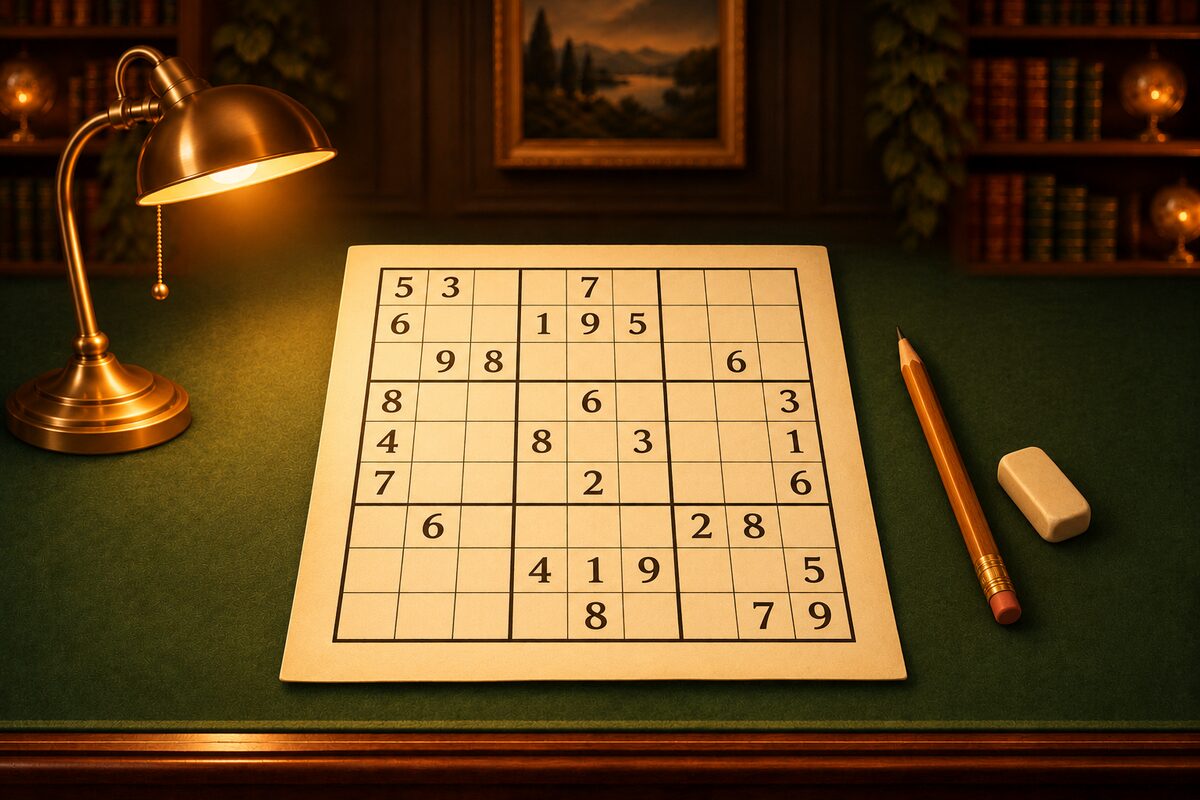
Sudoku is a puzzle often introduced as “brain training”. The NumberPlace app’s store listing has used the words “brain training” too. So which mental skills does it actually use?
First, a note: the NumberPlace app is not meant for testing, preventing, or treating forgetfulness, dementia, or any other condition. If you have any health concerns, please talk to a doctor.
The Mental Skills You Use While Solving
While you solve a single sudoku, you use several skills at the same time.
- Keeping your attention on it: You follow one digit across the board, asking “where can this digit go?”
- Remembering: You hold a lot of information in your head, such as “this row already has a 3” and “this square is 2 or 7”. If you try to solve without writing notes, this load gets heavier.
- Reasoning step by step: You draw conclusions from clues, like “if not here, then there” and “if A then B, and if not B then C”. The advanced techniques (Advanced Sudoku) are several of these chains linked together.
- Noticing what you missed: When you get stuck, you look back and switch to another way of seeing the board.
There’s no arithmetic, so you can play even if you aren’t good at math, and whether or not you’re good with words.
What Is Known and Not Known
The link between solving puzzles and brain health has been studied in many ways. However, it has not been confirmed that playing sudoku regularly reduces forgetfulness or prevents dementia.
- Some surveys have reported a tendency for people who often solve puzzles to score better on tests of mental skills.
- But surveys like these can’t tell whether it’s “thanks to the puzzles” or “people who are naturally good at them like puzzles”.
- Even if you get good at sudoku, it isn’t well understood how far that carries over to memory or judgment in other situations.
So think of sudoku not as “a medicine that works” but as a game that lets you enjoy using your head.
Tips for Keeping It Fun
- Choose a difficulty that’s just right: If it’s too easy it’s boring, and if it’s too hard it’s tiring. In the app you can choose ★1 to ★5, so find the stars you can solve with a little effort.
- Keep it short: With the 6×6 Mini, you can solve one puzzle in a short time (How to Solve the 6×6 Mini).
- Don’t race the clock: The app has no time limit, and the game doesn’t end if you make a mistake. Go at your own pace.
- Learn one new technique at a time: Learning techniques widens the range of puzzles you can solve. Try reading from How to Solve Sudoku onward.
- Take breaks: It’s fine to rest when you’re stuck. The app lets you pick up where you left off if you quit midway.
With Family and Friends
Solving the same puzzle separately and comparing times, or thinking together about where you’re stuck, are other ways to enjoy it. If you’re playing with a child, we recommend starting with 6×6 (Sudoku for Kids).