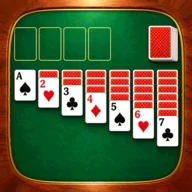
 Solitaire
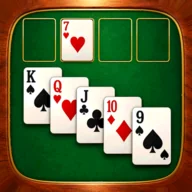 FreeCell
There are lots of card games, but what’s in the deck, how you shuffle, and the words people use are almost the same in every game. Here we sum up the basics you can use in any game.
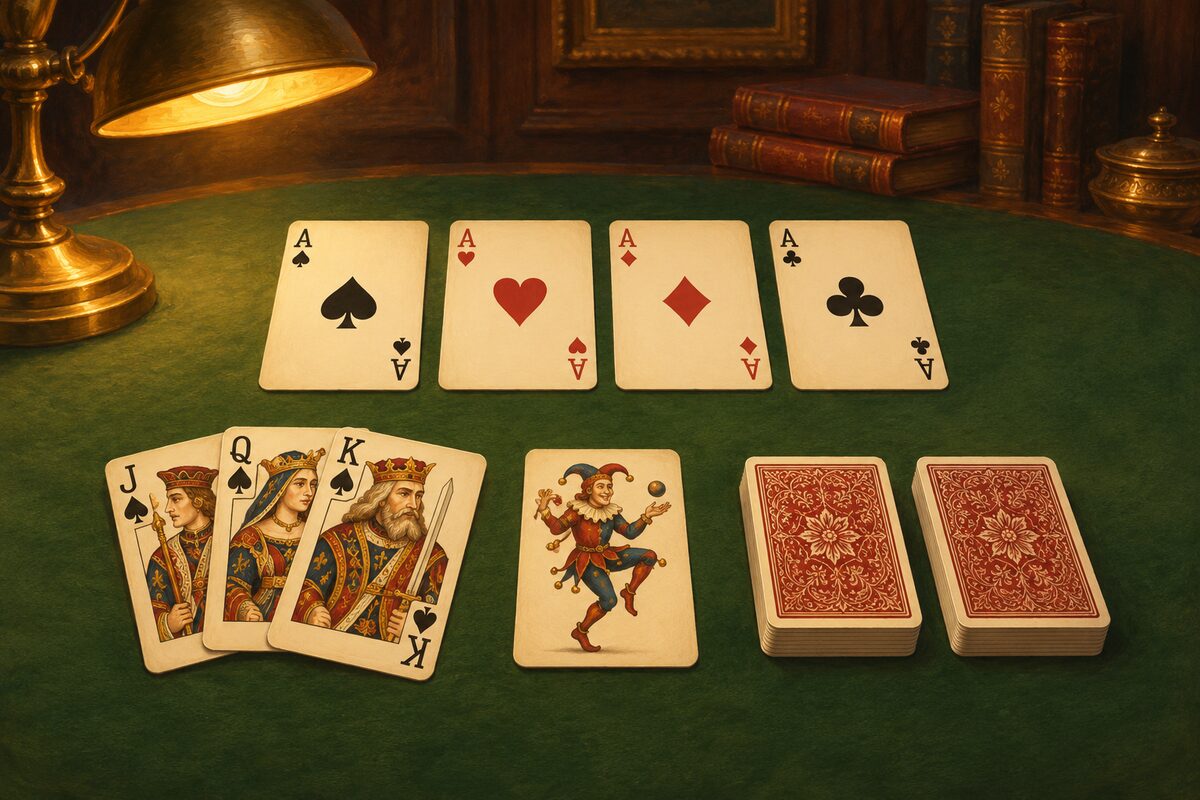
52 Cards Plus Jokers
A standard deck has 4 suits × 13 cards = 52 cards, plus one or two jokers.
| Suit | Name | Color |
|---|---|---|
| Spades ♠ | Spade | Black |
| Hearts ♥ | Heart | Red |
| Diamonds ♦ | Diamond | Red |
| Clubs ♣ | Club | Black |
Each suit has 13 cards: A (ace), 2 to 10, J (jack), Q (queen), and K (king). J, Q, and K show pictures of people, so they’re called “face cards.”
Some games use jokers and some don’t. Old Maid uses one as the “old maid,” while Solitaire and FreeCell don’t use them.
How to Count Numbers and Ranks
When you count cards as numbers, it’s usually A = 1, J = 11, Q = 12, K = 13. Games where you add numbers, like Pyramid, use this way of counting.
However, which card is strongest depends on the game.
- War and Poker: The A is often the strongest (above the K).
- President (Daifugō): 3 is the weakest, 2 is the strongest, and the joker is even higher.
- Solitaire: On the foundations you build up in order from A, and in the tableau the K goes at the top.
How to Shuffle
Mixing up the order of the cards is called “shuffling.”
- Overhand shuffle: Hold the deck in one hand and, with the other hand, pull off a few cards at a time from the top and stack them. It’s the shuffle you see most in Japan.
- Riffle shuffle: Split the deck in two and flick the cards with both thumbs so they fall alternately onto each other. It mixes them well.
- Wash: Spread the cards out on the table and stir them around with both hands. Even kids can do it, and it mixes the cards most reliably.
At the end, you may also “cut” the deck: split it into two piles and swap the top and bottom.
How to Deal
The basic way is to deal one card at a time, in turn, from the top of the deck. Dealing clockwise is common, but it varies by group and region, so check before you start. The dealer deals to themselves last.
Common Terms
| Term | Meaning |
|---|---|
| Hand | The cards you hold in your hand |
| Stock | The face-down pile left over after dealing |
| Discard pile | Cards you’ve finished with, placed face up |
| Tableau | Cards laid out on the table |
| Foundation | In Solitaire and similar games, the place where you build up from A |
| Dealer | The person who deals, or who starts first |
We show Solitaire’s tableau, stock, and foundations with diagrams in Solitaire Rules and How to Play.
Which Game Will You Play Next?
Once you’ve learned the basics, try all kinds of games. We introduce the classics for each number of players in Types of Card Games. If you want to practice alone, the Solitaire and FreeCell phone apps are an easy start.