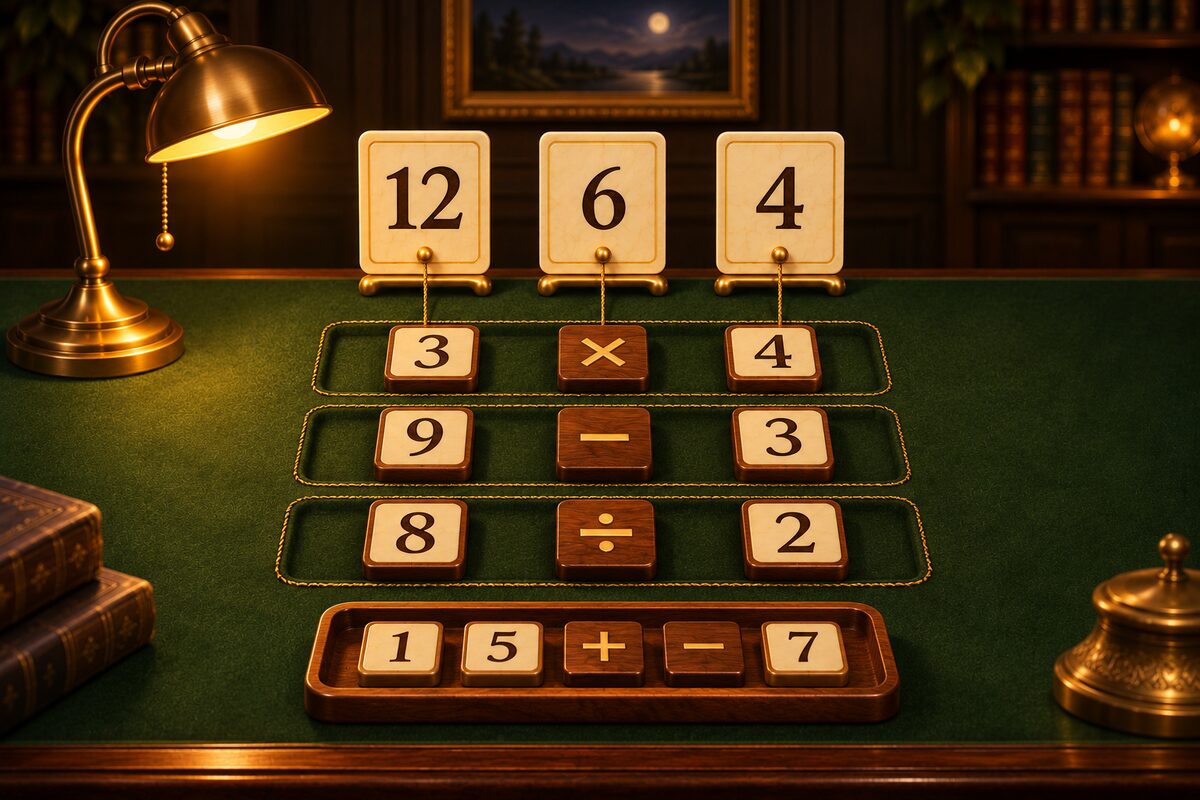
In Tsumezan, if you just try whatever equation comes to mind, you’ll often end up with tiles left over or too few, and get lost. Deciding the parts with the most clues first makes puzzles much easier.
1. Start with the Biggest Goal
The bigger the goal, the fewer ways there are to make it. Number tiles only go from 1 to 9, so making 40 or 50 with addition alone takes a lot of tiles. A big goal usually involves ×. For 49 it’s 7 × 7, for 56 it’s 7 × 8, so first check whether it’s close to a times-table answer.
2. Place ÷ Using Pairs That Divide Evenly
÷ only works when it divides evenly, so very few pairs can use it. If you have a ÷ tile, look for pairs of numbers that divide evenly first. Two 8s give 8 ÷ 8 = 1, and a 9 and a 3 give 9 ÷ 3 = 3. Once ÷ has a place, the other tiles narrow down too.
3. Read the Tiles per Row from the Number of Signs
If you put n number tiles in one row, it uses n − 1 signs. The number of signs is “number of numbers − number of goals,” so with 3 goals, 7 numbers, and 4 signs, for example, the numbers per row split like “2, 2, 3” or “1, 3, 3.” There can also be a row with just one number (a single tile matching the goal), so if you have a tile with the same number as a goal, keep it in mind as a candidate.
4. Goals of 0 and 1
- 0 comes from subtracting a number from itself (5 − 5), or an equation that works out to 0, like 6 ÷ 3 − 2.
- 1 usually comes from dividing a number by itself (7 ÷ 7) or subtracting neighboring numbers (5 − 4).
5. Subtract “from the Biggest Number”
Equations that drop below zero along the way aren’t allowed. For equations with subtraction, think about forms that start by subtracting from the biggest number, and you can rule out the equations that won’t work faster.
Let’s Solve One (a ★4 Puzzle)
Let’s follow the thinking with a ★4 (Master) puzzle from the app.
- Goals: 12, 6, 4
- Numbers: 3, 4, 9, 3, 3, 8, 8 (7 tiles)
- Signs: ×, −, +, ÷ (4 tiles)
① Where ÷ goes. Pairs that divide evenly include 8 ÷ 8, 9 ÷ 3, 3 ÷ 3, and 8 ÷ 4.
② Tiles per row. With 4 signs, the numbers in the 3 rows split into “2, 2, 3,” “1, 3, 3,” or similar.
③ The big goal, 12. With two tiles, it could be 3 × 4, 9 + 3, or 8 + 4. There’s only one × tile, so where you use × is the turning point.
④ Check the combination. If you make 12 as 3 × 4, the remaining tiles are 9, 3, 3, 8, 8 and −, +, ÷. 6 is 9 − 3, and making 4 from the remaining 3, 8, 8 with + and ÷ gives 3 + 8 ÷ 8 = 4.
The answer is 3 × 4 = 12, 9 − 3 = 6, 3 + 8 ÷ 8 = 4. This is the only answer to this puzzle. If you choose another split, like making 12 as 8 + 4, the tiles stop fitting somewhere.
If You’re Unsure
- Use a Hint to place one tile that leads to the answer. It also sends tiles that don’t fit back to the tray, so you can see where you went wrong.
- Another option is to go back with Restart and rethink from the biggest goal.
For a refresher on the rules, see How to Play Tsumezan. For the order of calculation, see Order of Operations.