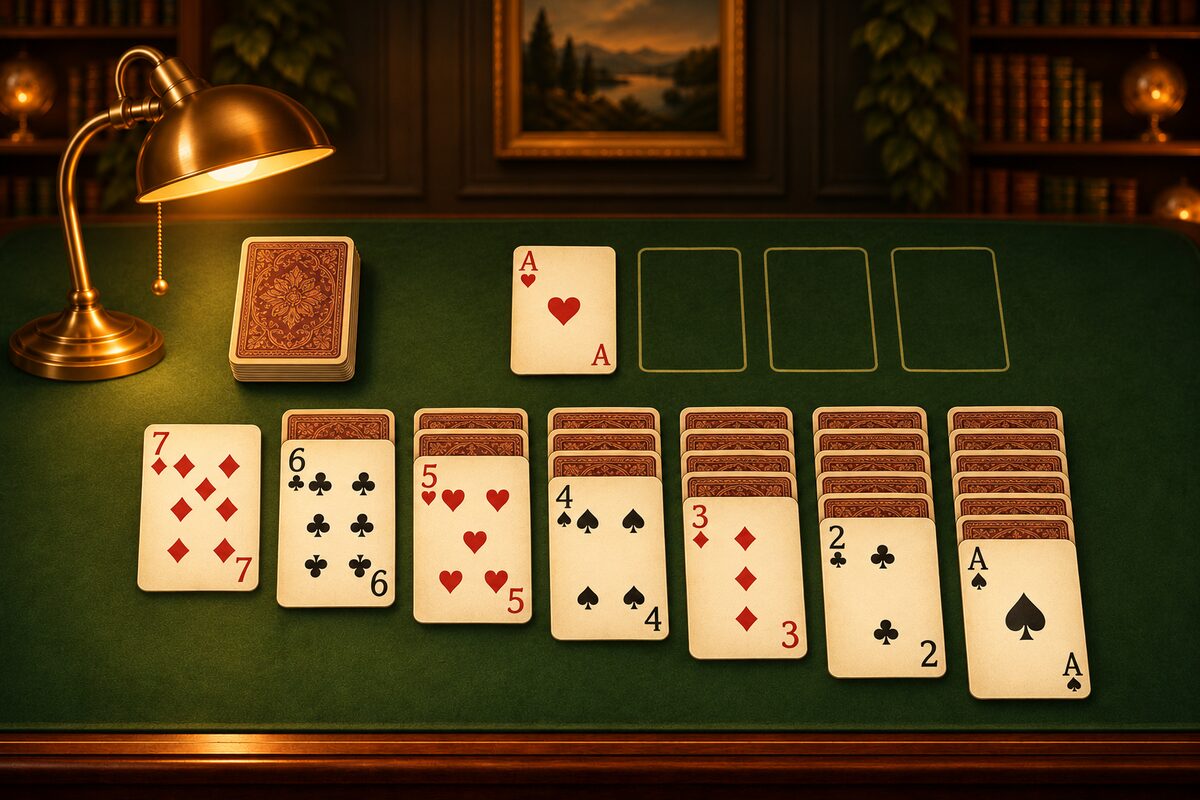
Right after you deal Solitaire (Klondike), the start varies from deal to deal: “This time I can see an ace,” or “This time I can’t move anything.” Here we work out the odds of those openings. We checked the numbers with combination calculations and with the results of dealing more than a million games on a computer and counting.
Where a Single Card Is
Right after the deal, the 52 cards are split among these three places.
| Place | Cards | Chance |
|---|---|---|
| Tableau, face up | 7 | 13.5% |
| Tableau, face down | 21 | 40.4% |
| Stock | 24 | 46.2% |
For example, the chance that the ace of hearts is among the seven face-up cards is 7 ÷ 52, about 13.5%. The stock is the most likely place for it, at nearly half.
The Chance of an Ace Among the Seven Face-Up Cards
The chance that at least one of the four aces is among the seven face-up cards is about 45.0%.
The easy way to calculate it is to subtract “the chance that none are there” from 1. Divide the number of ways to choose 7 cards from the 48 non-aces by the number of ways to choose 7 cards from 52, and you get the chance that no ace is among them (about 55.0%).
| Aces face up | Chance |
|---|---|
| 0 | 55.0% |
| 1 | 36.7% |
| 2 | 7.7% |
| 3 | 0.58% |
| 4 | 0.013% |
On average, about 0.54 aces are among the seven face-up cards (7 × 4 ÷ 52). A deal where all four aces are visible happens only about once in 7,700 deals.
The Chance That All the Aces Are Hidden
- The chance that all four aces are in the stock is about 3.9%.
- The chance that all four aces are face down in the tableau is about 2.2%.
The same goes for kings: the chance that all four kings are in the stock is about 3.9%. If a K is buried deep in the tableau, it’s harder to make use of an empty column.
The Chance That You Have a Move at the Start
If, among the seven face-up cards right after the deal, there’s a pair that alternates red and black and differs by one number (for example, a black 8 and a red 7), they can be stacked on the tableau. We dealt a million games on a computer and counted:
- There’s a pair you can stack: about 82%
- There’s a pair you can stack, or an ace you can move to a foundation: about 91%
- Neither: about 9%
About once in 11 deals, you can’t do anything with the tableau alone right after the deal, and you start by turning over the stock. Even so, the deal isn’t necessarily unsolvable.
Odds and Winning or Losing
It feels good to start with an ace in sight or plenty of moves available. But a good or bad start doesn’t decide whether you win. The face-down cards and the order of the stock can change how the game goes a great deal.
Every deal in the Solitaire app has been checked by a computer to make sure it has a solution, so even if the start looks bad, there is always a way to clear the game (How We Make Solvable Deals). For the number of possible deals, see How Many Ways Can Solitaire Be Dealt?, and for win rates, see Solitaire Win Rates.