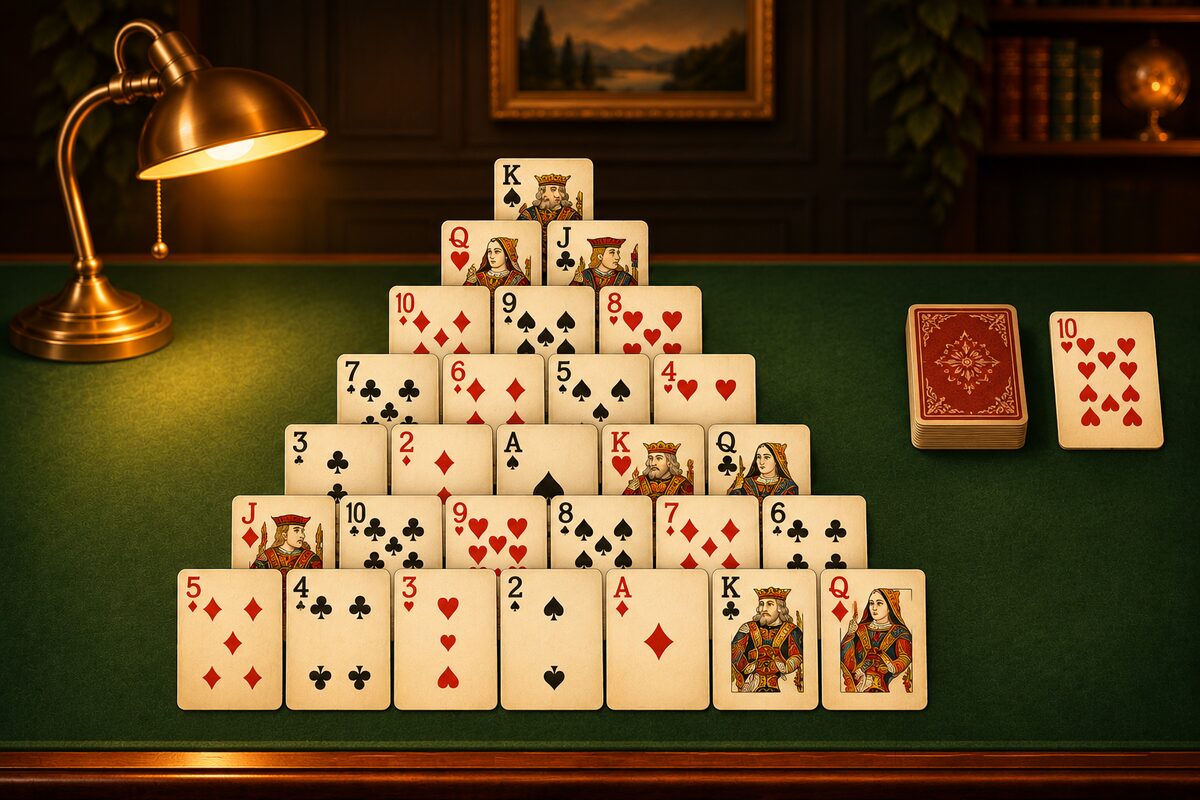
Pyramid is a game where, depending on the deal, you may not be able to clear it however you take the cards. The Pyramid app doesn’t pick only winnable deals, either. So how many deals can be solved? We calculated it with the same rules as the app.
The Rules We Checked
The rules of the Pyramid app are as follows (Rules and How to Play).
- You clear the game by removing all 28 pyramid cards. It’s fine if cards are left in the stock.
- Two face-up cards that total 13 can be removed. A K can be removed by itself.
- You turn over the stock one card at a time, and only the top card of the waste pile can pair with a pyramid card. Turned-over cards can’t pair with each other.
- When the stock runs out, you can use it from the start as many times as you like.
Since you can recycle the stock as many times as you like, every card left in the stock can be used eventually if you turn it over again. So in the calculation, we represented the stock only by “how many of each number are left” and checked every order of removal.
About 67% of Deals Are Solvable
These are the results from 100,000 randomly shuffled deals.
| Method | Share solved |
|---|---|
| Face-down cards known, best order of removal | About 66.6% |
That means about two deals in three can be solved, and one in three can’t be solved however you take the cards.
However, this is the number when every face-down card is known. When you actually play, you decide the order without knowing what the face-down cards are, so your win rate is lower than this.
How Much Does Your Playing Policy Matter?
We had 20,000 games played to the end with policies that don’t look at the face-down cards. In every policy, the numbers of the cards left in the stock are assumed to be known (you can find out what’s in the stock by going through it once).
| Policy | Share won |
|---|---|
| Pick randomly from the pairs you can take | About 11% |
| Pairs within the pyramid first, then pairs that open the most cards | About 43% |
| Face-down cards known, best order | About 67% |
If you take pairs at random, you win only about one game in ten. With just the simple policies of “pairs within the pyramid first” and “pairs that open the upper rows first”, the share you win became about four times higher. It shows that thinking about the order of removal matters. The ideas are in Pyramid Tips.
Why Are Some Deals Unsolvable?
The easiest case to see is the top card. The top card doesn’t turn face up until you’ve taken all the other 27. If the top card is a 7 and all four 6s are inside the pyramid, you need four 7s to take the 6s, but the top 7 can’t be used until the end. About 6.6% of the 100,000 deals were like this. See Examples of Unwinnable Deals for details.
Different Rules Change the Win Rate
Some versions of Pyramid have different rules for how many times you can use the stock and which cards can pair. The fewer times you can use the stock, the fewer cards you can use, so fewer deals can be solved. The numbers here were calculated with the Pyramid app’s rules.
Summary
- Under the Pyramid app’s rules, about 67% of deals can be solved even when every face-down card is known.
- One deal in three can’t be solved however you take the cards.
- Taking pairs at random wins about 11%, and even a simple policy raises it to about 43%.
When you find out a deal can’t be solved, moving on to the next deal with “New game” is an option, too.