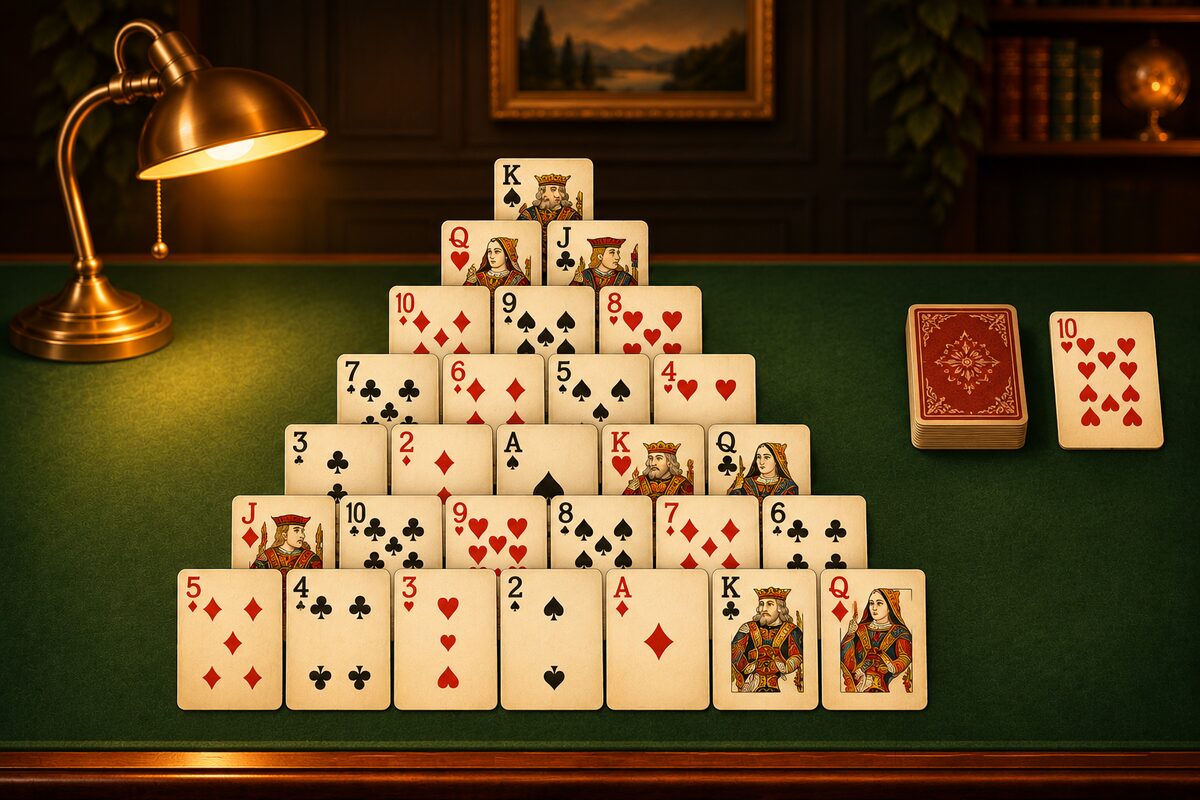
There are interesting numbers hidden in the way Pyramid is laid out. This article looks at the numbers behind the shape of the pyramid.
28 Cards Make a Triangular Number
In Pyramid, you lay out 1 card in the first row, 2 in the second, and so on up to 7 in the seventh row.
1 + 2 + 3 + 4 + 5 + 6 + 7 = 28
A number made by adding up from 1 like this is called a triangular number, because it’s the number of cards or stones you get when you arrange them in a triangle. For seven rows, you can also get it as 7 × 8 ÷ 2 = 28. If you lay out 28 of the 52 cards, the stock is 24 cards.
The Higher the Card, the More Cards to Take First
A card in an upper row turns face up when the two cards below it are gone. Those two can’t be taken until the two cards below each of them are gone, too. In other words, to turn a card face up, you have to take all the cards spread out below it in a triangle.
To turn up the gold-outlined card in the diagram above (the middle of the third row), you first take the 14 cards that aren’t dimmed. Counting by row, it looks like this.
| Row of the card | Cards to take first |
|---|---|
| Row 1 (top) | 27 |
| Row 2 | 20 |
| Row 3 | 14 |
| Row 4 | 9 |
| Row 5 | 5 |
| Row 6 | 2 |
| Row 7 | 0 |
Add 1 for the card itself, and you get 28, 21, 15, 10, 6, 3, and 1, triangular numbers again. You can’t use the top card until you’ve taken all the other 27 (Examples of Unwinnable Deals).
At Most Seven Cards Can Be Face Up at Once
When a card is face up, all the cards spread out below it have been removed. So two face-up cards never overlap one above the other.
The pyramid can be divided into seven diagonal lines running from upper left to lower right. You can have at most one face-up card from each line, so at most seven cards can be face up at once. The seven cards in the bottom row at the start are exactly that maximum.
There Are 1,430 Shapes It Can Collapse Into
As you play, the pyramid collapses into all kinds of shapes.
If you follow the rule that “an upper card can only be taken after the two below it are gone”, how many shapes are possible? Counting them all gives the following (including the full shape and the completely empty shape).
| Rows | Number of shapes |
|---|---|
| 1 row | 2 |
| 2 rows | 5 |
| 3 rows | 14 |
| 4 rows | 42 |
| 5 rows | 132 |
| 6 rows | 429 |
| 7 rows | 1430 |
The sequence 2, 5, 14, 42, 132, 429, 1430 is a well-known sequence in mathematics called the Catalan numbers. It shows up in many places, such as counting the ways to arrange parentheses correctly or the paths on a grid.
A seven-row pyramid has 28 cards, but only 1,430 shapes it can collapse into. That’s one reason the number of positions to check doesn’t get very large when a computer searches for a solution (Pyramid Strategy and Winning Methods).
Summary
- 28 cards is a triangular number, the sum of 1 through 7.
- The higher the card, the more cards you take first. For the top card, it’s 27.
- At most seven cards can be face up at once.
- There are 1,430 shapes in total partway through a game (a Catalan number).