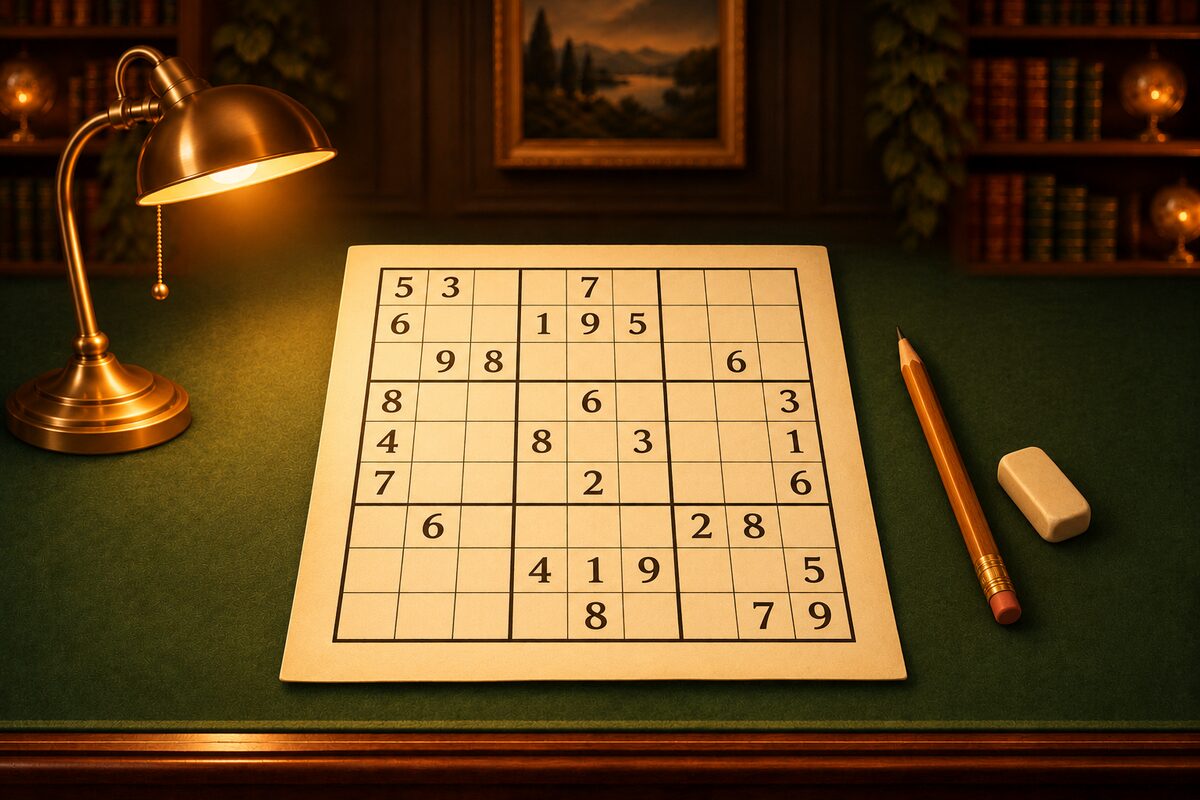
A sudoku puzzle is, by convention, made so that it has only one solution. If there are two or more solutions, you’d have to pick one by guessing somewhere, and it wouldn’t be a puzzle solved by logic alone.
An Example with Two Solutions
The board below is a completed board with the digits erased from just four squares. In the empty squares, the digits that can go in (the candidates) are written.
All four squares have the candidates 4 and 9.
- If row 2, column 5 is 4, then row 2, column 8 is 9, row 3, column 5 is 9, and row 3, column 8 is 4.
- If row 2, column 5 is 9, then row 2, column 8 is 4, row 3, column 5 is 4, and row 3, column 8 is 9.
Both follow the rules, so there are two solutions. Even though only four squares are empty, there is no way to decide these four.
When four squares at the corners of two rows and two columns span two boxes and make a shape where the same two digits can be swapped, the answer isn’t settled to one. When making a puzzle, you have to leave a digit in one of those squares so that this shape doesn’t remain.
A Puzzle Solvable with Techniques Has One Solution
Every technique moves forward using only things you can say for certain: “only this digit can go in this square” and “this digit can’t go in this square”.
If you could solve all the way from the starting digits with techniques alone, every single move was one that “had to be that way”. If there were another answer, it would clash somewhere with a move that “had to be that way”. So a puzzle that can be solved with techniques alone has only one answer.
The NumberPlace app uses this property to make its puzzles. Each time it erases digits, it checks whether the puzzle can still be solved with techniques alone, and erases only when it can (How a Sudoku Is Made). That’s why every puzzle in the app has one answer and can be solved all the way without guessing.
How to Count the Number of Solutions
Even for a puzzle that can’t be solved with techniques, you can check whether it has one solution. On a computer, you put digits into empty squares in order, and when you get stuck you step back (backtracking), and look for every answer. As soon as two answers are found you know it isn’t exactly one, so you can stop there (Sudoku Solving Algorithms).
The app also uses this method to check that a puzzle has one answer when it loads a half-played puzzle from its saved data.
What It Means for the Solver
If you know there is one solution, you can use it as a clue, too. For example, a “swappable shape” like the four squares above should never appear in a puzzle with one solution. Experienced solvers sometimes use this the other way around to cross out candidates. But this way of thinking assumes “there is one solution”, so it isn’t something you can say from the rules alone. The app’s Hint doesn’t use this way of thinking, and points to the next square using only techniques that can be stated with certainty from the rules.