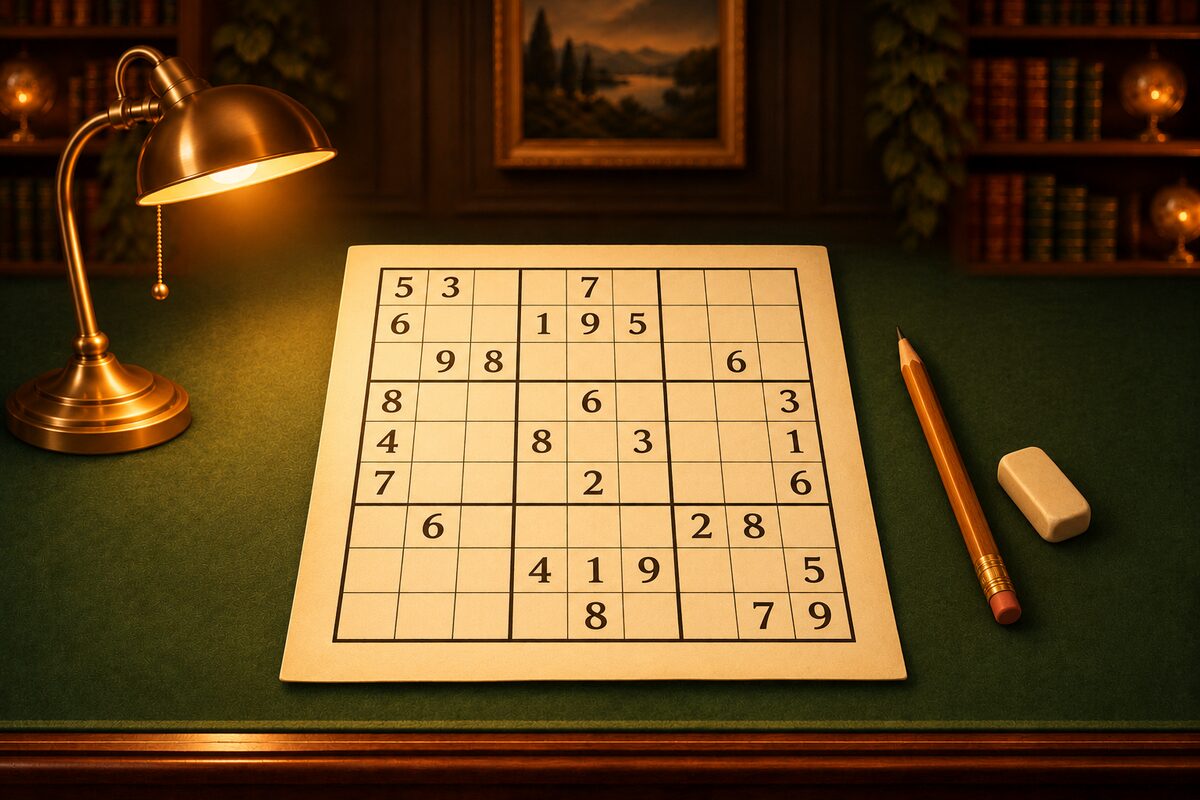
Sudoku is known around the world by its Japanese name, but it is said to have been born in the United States. Many parts of its history are disputed, so this article covers what is widely said, within what is reliable.
Its Ancestor: The Latin Square
A table arranged so that every row and every column holds each symbol exactly once is called a Latin square. It is known from the research of the 18th-century mathematician Euler. A completed sudoku board is a Latin square with the added condition that each box holds each symbol once, too.
However, the Latin square was an object of mathematical research. It wasn’t made as a “puzzle you enjoy by filling in digits” like sudoku.
“Number Place” in America
A puzzle with nearly the same rules as today’s sudoku is said to have first appeared in the late 1970s in an American puzzle magazine under the name ”Number Place”. Its creator is said to have been a man who was an architect in the United States.
The Japanese name “Nanpure” is a shortened form of this Number Place.
Becoming “Sudoku” in Japan
This puzzle was introduced to Japan in the 1980s, and the puzzle publisher Nikoli is said to have published it under a name meaning “digits must be single” (Sūji wa dokushin ni kagiru). The shortened form of that is ”Sudoku”. Because “Sudoku” is a registered trademark of Nikoli, other publishers in Japan more often used the names “Number Place” and “Nanpure” (Sudoku vs. Number Place).
In Japan, a particular care is said to have developed about how puzzles are made. Making the layout of the starting digits symmetrical so it looks tidy, and making a puzzle that can be solved by logic alone without guessing, are ideas that puzzle lovers in Japan have valued.
The 2000s: A Worldwide Craze
In the mid-2000s, a British newspaper began running sudoku, and that is said to have set off a craze in Europe and America. At that time the Japanese name was used as it was, and in English too it came to be called ”Sudoku“.
So a puzzle born in America gained a name and ways of making it in Japan, and spread around the world under its Japanese name.
World Championships and Many Variants
After the craze, tournaments began to be held around the world, and world championships are said to have been held since the late 2000s.
Many variants that add rules or change the shape were also born, such as Killer Sudoku, Greater Than Sudoku, and Jigsaw Sudoku (Sudoku Variants).
Computers and Sudoku
Sudoku also became a subject of research in mathematics and computer science. It is said that computers were used to confirm that there are about 6.67 × 10^21 completed boards (How Many Solutions Are There?) and that the minimum number of clues that gives a unique answer is 17 (What Is the Minimum Number of Clues?).
The NumberPlace app also makes its puzzles on the spot with a computer, and releases them only after confirming they can be solved with the same techniques a person uses (How to Make a Sudoku).