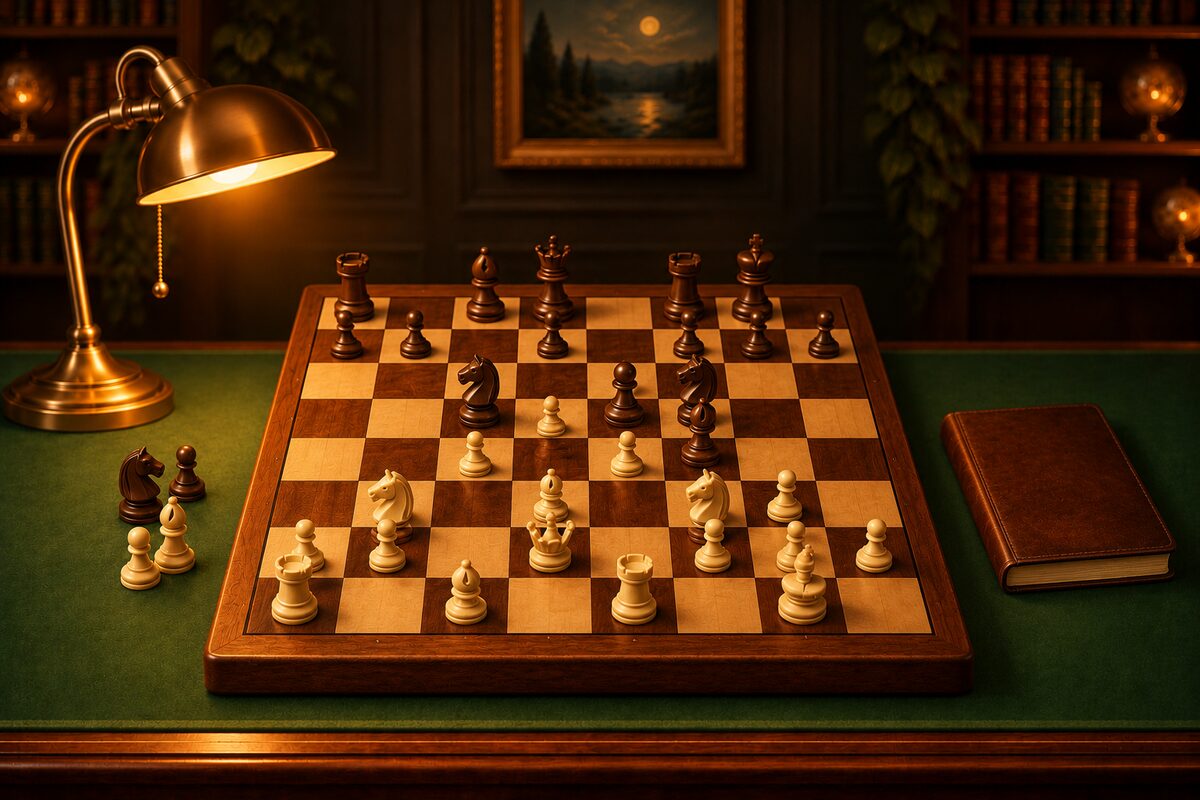
In chess, you win by checkmating your opponent’s king. This article uses board diagrams to explain what checkmate is and how it differs from the similar-sounding “check.”
The Difference Between Check and Checkmate
- Check: A position where you could capture the opponent’s king on your next move. The side in check must deal with it right away.
- Checkmate: A position where the king is in check and no move can stop it. The game ends at that point.
The king is never actually captured. The moment it is clear that the check can’t be stopped, the game is decided.
In the diagram below, White’s queen is checking Black’s king. Black can push a pawn to g6 and block the queen’s path. Because Black can stop it, this is not checkmate.
Three Ways to Answer a Check
When you are in check, you stop it in one of these three ways. If you can’t do any of them, it is checkmate.
- Move away: Move the king to a square where it can’t be captured.
- Capture: Capture the piece that is giving check.
- Block: Put one of your own pieces between the king and the checking piece.
If a knight is giving the check, there is no square in between to block, so your only choices are to move away or capture. When two pieces give check at once (double check), you can’t capture or block both with one move, so the king has to move.
How to Spot It
To tell whether it is checkmate, check the three options above one by one.
- Is every square around the king either attacked by the opponent or blocked by your own pieces?
- Can any of your pieces capture the checking piece? (Also check that the capture doesn’t leave your king in danger again.)
- Is there no piece that can move in between?
Checkmates in Short Games
The Checkmate in Two Moves
The shortest checkmate happens on Black’s second move. White pushes the f- and g-pawns and opens up the diagonal to the king, and Black’s queen mates from h4. If you look at every combination of the first four moves (two by White, two by Black), no sequence ends in checkmate sooner than this.
The Checkmate in Four Moves
White’s bishop and queen aim at f7, a weak square in Black’s position. At the start, f7 is guarded only by Black’s king, so if two pieces attack it, you can easily get checkmated if you aren’t careful.
Black can prevent this on the third move by driving the queen away with g6 or the like, or by guarding f7 with the queen (such as Qe7).
Basic Checkmates in the Endgame
In the endgame, when few pieces are left, you bring your king along to help deliver checkmate. The basic idea is to drive the opponent’s king to the edge of the board.
It is known that with one queen, or one rook, plus your king, you can always force checkmate against a lone king. With a king and one bishop, or a king and one knight, there is no way to arrange the pieces for checkmate, so the game is a draw.
When You Think You’ve Won but It’s a Draw
If you corner the opponent’s king but the opponent has no legal move while not in check, it is a stalemate and the game is drawn. This is the pattern the winning side most needs to watch out for. When you drive the king in, leave it one square to move to, and make your final move a check.
In the App
The Chess Board app detects checkmate automatically. When checkmate happens, it shows the winner, like “White wins · Checkmate,” and the losing king falls over on the board. When a king is in check, the turn display adds “Check.”
How the pieces move is covered in How Chess Pieces Move and What They’re Called, and the full rules in The Rules of Chess.