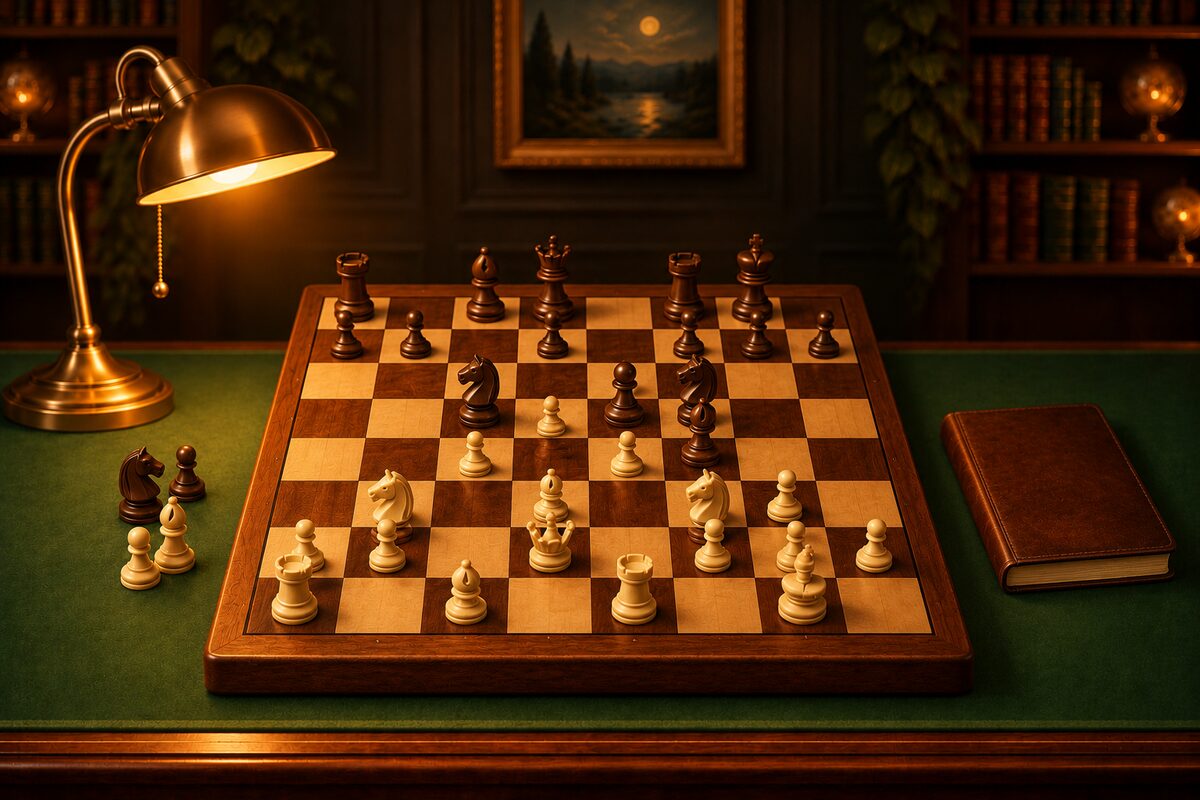
In chess you can’t use the pieces you capture, so whether you came out ahead or behind in the captures matters all the way to the end. A common yardstick for gains and losses is to give each piece a point value and count.
The Commonly Used Guide
| Piece | Points |
|---|---|
| Pawn | 1 |
| Knight | 3 |
| Bishop | 3 |
| Rook | 5 |
| Queen | 9 |
The king is given no points, because losing it means losing the game. These are not rules but a guide used in many books and lessons. Some people use slightly different numbers, such as valuing a bishop a little above a knight.
In the starting position, the pieces other than the king add up to 8 for the pawns, 6 for the knights, 6 for the bishops, 10 for the rooks, and 9 for the queen, which is 39 points per side.
How to Think About Exchanges
When you capture an enemy piece, check whether it can be recaptured afterward.
In the diagram above, if White captures the pawn with Nxe5, Black can recapture the knight on e5 with the knight on c6. White gains 1 point for the pawn but loses 3 points for the knight, a net loss of 2 points.
- A piece that is not protected can simply be captured for a gain.
- When you capture a protected piece, compare the points of the capturing piece and the captured piece.
- When captures continue on one square, count to the end before you capture.
Trades and “the Exchange”
Capturing pieces of about equal value is called a trade. Examples are knight for bishop, or rook for rook.
Trading a rook (5 points) for a knight or bishop (3 points) is specifically called the exchange in chess. The side that captured the rook has “won the exchange,” and the side that lost the rook has “lost the exchange.”
When the Points Don’t Tell the Whole Story
The points are only a guide, and a piece’s usefulness changes with the position.
- Two bishops: Having both bishops lets you control light and dark squares, so the pair is said to be worth more than its points.
- An advanced pawn: A pawn close to promotion is worth much more than 1 point.
- A piece that can’t move: A bishop hemmed in by its own pawns, for example, does less than its points suggest.
- King safety: Even if you lead in points, you can lose if your king is in danger. Once you are checkmated, the points don’t matter.
- The king in the endgame: When few pieces are left, the king becomes an important piece that joins the fight actively.
When You’re Starting Out
Just keep two things in mind: “don’t leave a piece to be captured for nothing,” and “capture any piece that can be taken for nothing.” That alone will make you much stronger. After every move, get in the habit of checking whether all your pieces are protected.
In the Chess Board app, the pieces each side has captured line up above and below the board, so you can see at a glance who has taken what.
How the pieces move is in How Chess Pieces Move and What They’re Called, and opening ideas in Chess Openings.