 NumberPlace
 Shisen-Sho
 Tower of Hanoi
 Peg Solitaire
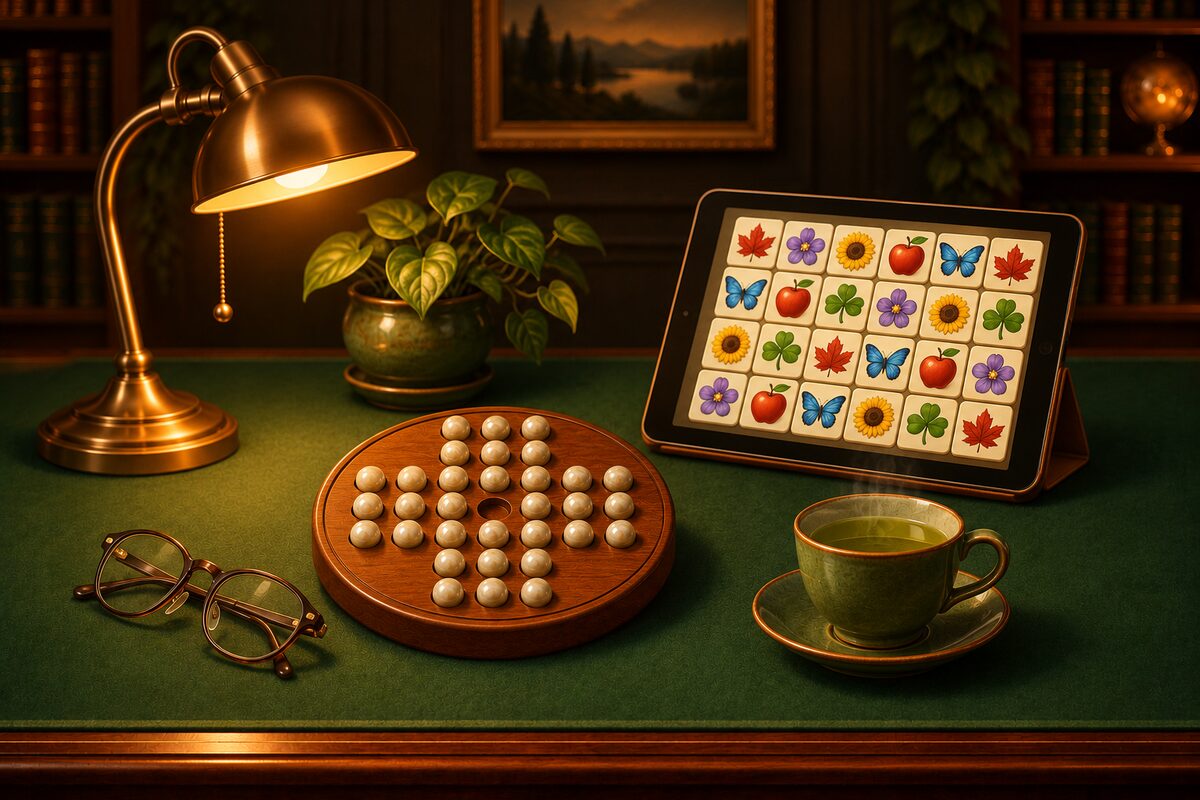
Even as you get older, time spent enjoying thinking can add a sense of purpose to daily life. Here is brain training that older adults and seniors can keep up with comfortably and enjoyably.
Note that it’s still not clear whether puzzles and games can prevent dementia. What research has found is summarized in Can Games Help Prevent Dementia?. The picks here are made with the goal of “having time to use your head, as something you enjoy”.
Puzzles We Recommend for Seniors
| Puzzle | Skills used | Difficulty |
|---|---|---|
| Shisen-Sho (also called Nikakudori) | Observation, memory | ★ |
| Tower of Hanoi | Steps, planning | ★–★★★ |
| Peg Solitaire | Thinking ahead | ★★ |
| NumberPlace | Logic, focus | ★–★★★ |
| Concentration (Memory) | Memory | ★ |
Shisen-Sho: Easygoing Tile Matching
A puzzle where you connect tiles with the same picture, two at a time, with a line and remove them. The line can bend up to two times. Since you’re only looking for matching pictures, the rules are quick to understand, and there’s the fun of searching with your eyes. It’s especially recommended if you’re familiar with mahjong tiles. There’s more in How to Play Shisen-Sho.
Tower of Hanoi: Adjust the Difficulty with the Number of Disks
A puzzle where you move disks one at a time without putting a larger disk on a smaller one. It takes 7 moves with 3 disks and 15 moves with 4, so you can fine-tune the difficulty with the number of disks. It’s a puzzle that is sometimes used in rehabilitation and psychological testing (The Tower of Hanoi in Psychological Testing and Rehabilitation).
Peg Solitaire: Take Your Time on Your Own
A puzzle where you remove pegs on the board by jumping over a neighboring peg, aiming to leave just one at the end. Many people have played it on a wooden board. The more you think ahead, the better you get.
NumberPlace: A Daily Habit of One Puzzle
A puzzle where you fill the grid so that the numbers 1 to 9 appear once each in every row, column, and box outlined in bold. It’s a familiar puzzle from newspapers and magazines, and you can start with easy ones. Starting with a small 6×6 grid is also a good idea.
What to Look For
- No time pressure: Games with a time limit can make you rush and stop enjoying them. Choose puzzles you can think through at your own pace.
- Easy-to-see text and board: On a tablet, the board is bigger and easier to see than on a phone.
- Easy to redo: An app where you can quickly undo a mistake with “Undo” makes it pleasant to keep going.
- Short to finish: If a game takes about 5 minutes, you can stop before you get tired.
Tips for Keeping It Up Comfortably
- Set a time and make it a habit: Choosing a time to play, like morning tea or after dinner, makes it easier to keep going.
- Start with easy puzzles: The best thing is to build up the good feeling of solving them. If they feel too hard, don’t hesitate to make them easier.
- With family and friends: Solving the same puzzle and showing each other, or playing with your grandchildren, gives you more to talk about and spreads the fun.
- Move your body too: Along with time using your head, make time for moving your body, like walks or exercises.
Playing on a Phone or Tablet
All the puzzles above can be played with free apps. NumberPlace, Tower of Hanoi, and Peg Solitaire are on iPhone and Android, and Shisen-Sho is on Android (ads are shown). At first, it’s reassuring if a family member installs the app and goes over how to play together.