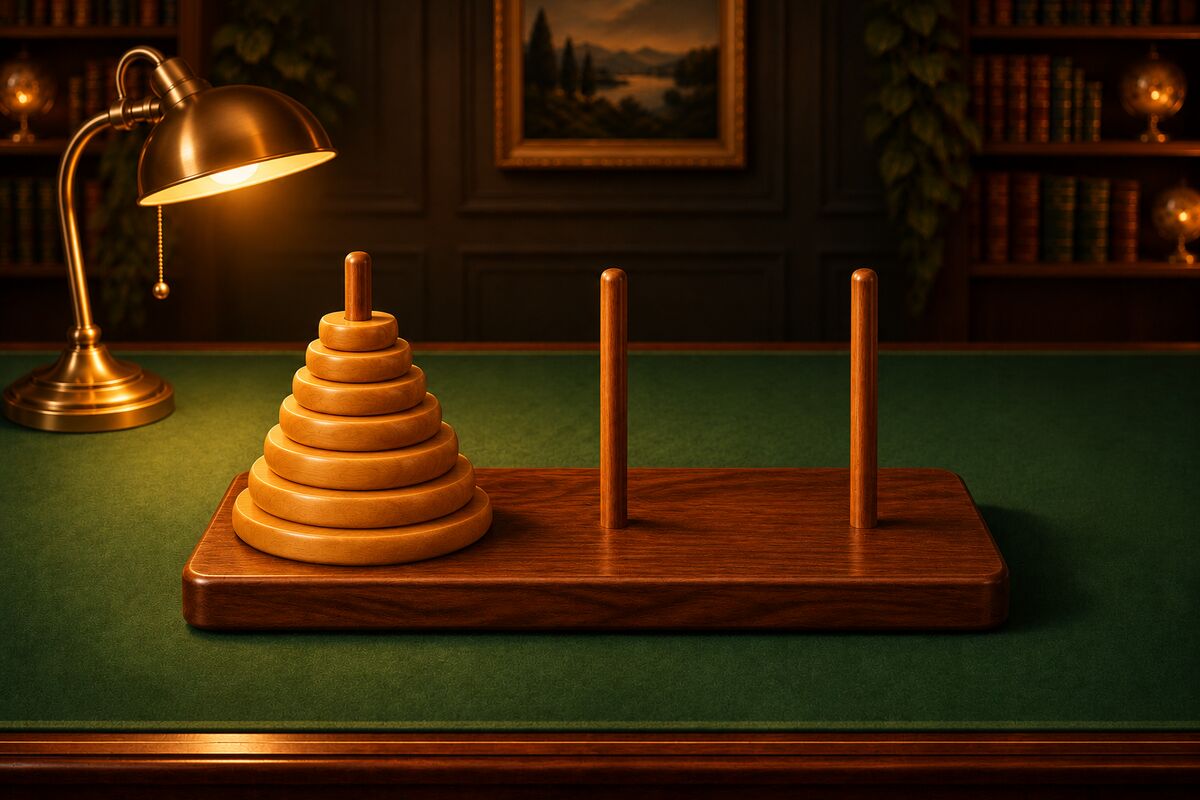
The Tower of Hanoi is a puzzle that people have played for over 140 years, and it is also a well-known tool in psychology. Its rules are simple and results can be compared by a clear number, the number of moves, so it has long been used in research on how people solve problems.
This article introduces how the Tower of Hanoi is used. It does not explain methods of testing, diagnosis or treatment.
A Task That Looks at “Planning Ahead”
To solve the Tower of Hanoi in few moves, you must not start moving disks right away. You need to think “to move a large disk, where should I put the small disks aside first?” It is the ability to set intermediate goals toward a goal and build the steps in your head.
In psychology, this kind of function, making a plan toward a goal and switching actions as you go, is called “executive function”. The Tower of Hanoi has been used in research and testing as a task related to one part of executive function, in particular the ability to plan. Researchers record the number of moves taken to solve it, the time taken, the number of rule violations and so on.
The Similar “Tower of London” Task
A task based on the Tower of Hanoi is the “Tower of London” task. It was devised in 1982 by the British psychologist Tim Shallice, and uses three poles of different heights and three balls of different colors. You move the balls one at a time to match a target arrangement.
Unlike the Tower of Hanoi, the balls are all the same size, and each pole can hold a set number of balls. The fewest moves differs from problem to problem, so it is easy to make problems with finely varied difficulty. The Tower of Hanoi app’s Puzzles mode (the way of playing where you match scattered disks to a target shape) is also a little like the Tower of London task in that you match a target.
In Memory Research Too
The Tower of Hanoi has also been used in memory research. It has been reported that even people with memory impairment who have trouble remembering new events can improve their skill at solving the Tower of Hanoi after practicing for several days. It has been taken up in research on skill and procedural memory (procedural learning) as an example showing that “even if you do not remember practicing, a procedure your body has learned can still improve.”
In Rehabilitation
In rehabilitation after illness or injury, puzzles like the Tower of Hanoi are sometimes used as one of the tasks in occupational therapy and similar settings. This is because you can practice picking up and moving disks by hand, thinking about the order, and seeing a task through to the end all at once. Which tasks to do and how much is decided by specialists such as doctors and occupational therapists, to suit each person’s condition.
What to Know When You Play
- We cannot say that playing the Tower of Hanoi can prevent or cure illness.
- The Tower of Hanoi used in research and testing is carried out with set procedures, numbers of disks and ways of recording. The result of playing at home cannot be compared with test results or used for judgments.
- If you are worried about forgetfulness or trouble thinking, please consult a medical institution or a local consultation service.
The Tower of Hanoi app is also a game for enjoyable play, not for testing or treatment. If you want to enjoy it as a mental workout, The Tower of Hanoi as Brain Training for Adults introduces tips for keeping it up without strain.