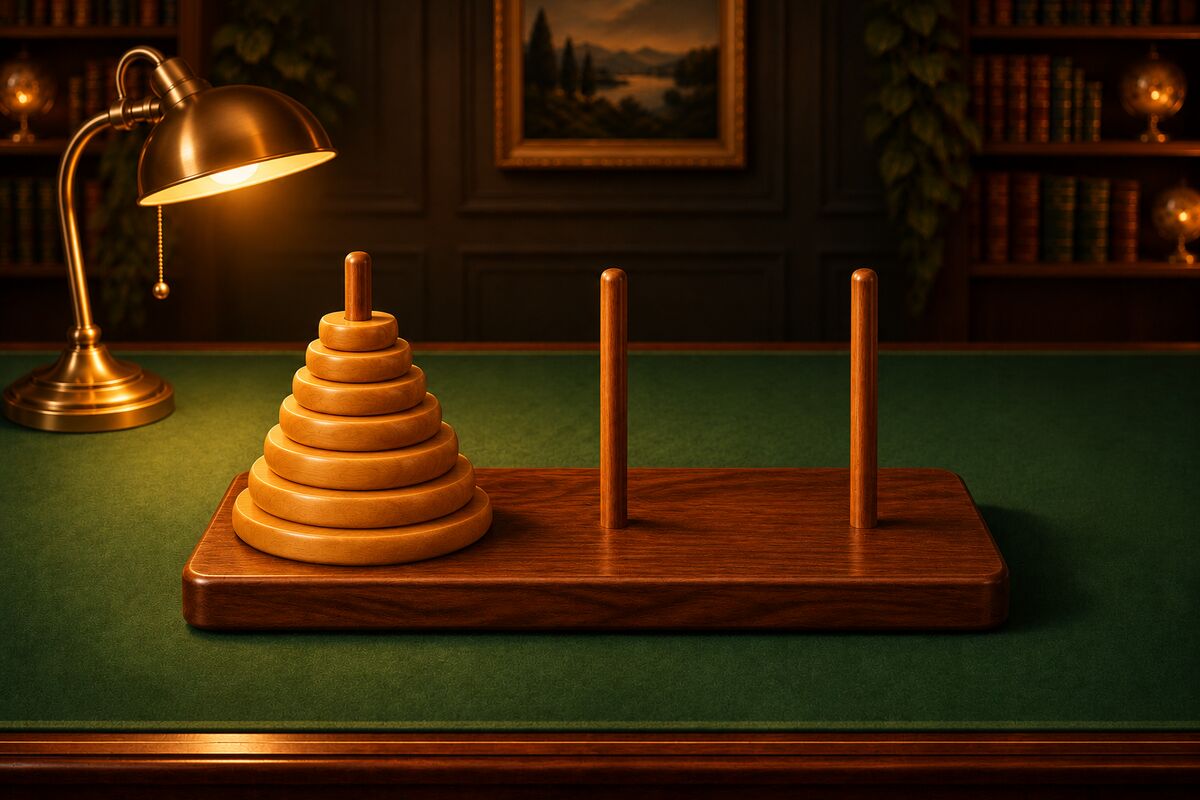
The Tower of Hanoi is known as an educational toy for children, but it is a deep puzzle for adults too. You can play a round in a few minutes, and you can see yourself improving in moves and time, so it is easy to keep up as a daily mental workout.
Why the Tower of Hanoi Suits a Mental Workout
- Planning ahead is fun: To move a large disk, you have to think about where to put the small disks aside first. There is the fun of thinking a few moves ahead and building a plan.
- You can see yourself improving in numbers: The fewest moves is fixed, so you can check your own progress: “I got the fewest moves today” or “I was faster than yesterday.”
- It fits in a short time: Even 7 disks take about 4 minutes. You can play between chores or during a break.
- The rules are simple: There are only three rules. You can start right away without reading a manual.
Tips for Keeping It Up Every Day
- Set a time: Deciding when to play, such as “once after my morning coffee”, turns it into a habit.
- Keep a record: Jotting down your moves and time makes your improvement easy to see.
- Make it a little harder, a little at a time: When it gets easy, add one disk. If it is too hard you will not keep going, so “doable with a little thought” is just the right difficulty (difficulty by number of disks).
- Rest when tired: Short and fun beats long. If you get stuck, wait a while and try again.
Ways to Play Once You Are Used to It
Once you have memorized the method, changing how you play lets you use your head in a new way again.
- Aim for exactly the fewest moves: With 7 disks, that is 127 moves. Not wasting a single move takes more concentration than you might expect.
- Time attack: Keep to the fewest moves and see how fast you can go.
- Solve it in your head: Try saying the moves for 3 or 4 disks out loud without looking at the board. If you can say “1 to the right, 2 to the middle, 1 to the middle…”, you are an expert.
- Change the destination: If you always move to the right, try moving to the middle. The direction of the method changes, so you cannot simply reuse the method you memorized (the article on how to solve it).
- From a scrambled position to the target shape: The app’s Puzzles mode starts from a different arrangement each time and asks you to match the target shape, so a memorized method alone will not solve it (Puzzles mode guide).
Settings That Make the App Easier to See
In the Tower of Hanoi app, you can adjust how easy it is to see in Settings.
- Show disk numbers: Numbers appear on the disks, from smallest to largest. It makes disks of similar size easier to tell apart.
- Disk and pole height: You can choose “Low”, “Standard” or “High”. If you find it easier to tap when the disks look thicker, “High” is recommended.
- Text size: On iPhone and iPad, the display also follows the setting for larger text on your device.
Enjoying It Is What Matters Most
We cannot say that playing the Tower of Hanoi prevents illness. How it is used in research and testing is explained in The Tower of Hanoi in Psychological Tests and Rehabilitation. Rather than worrying about effects, enjoying “the good feeling when you solve it” is the best tip for keeping it up for a long time.
Give It a Try
Play today’s round on the board below. If you are used to it, start with 7 disks.