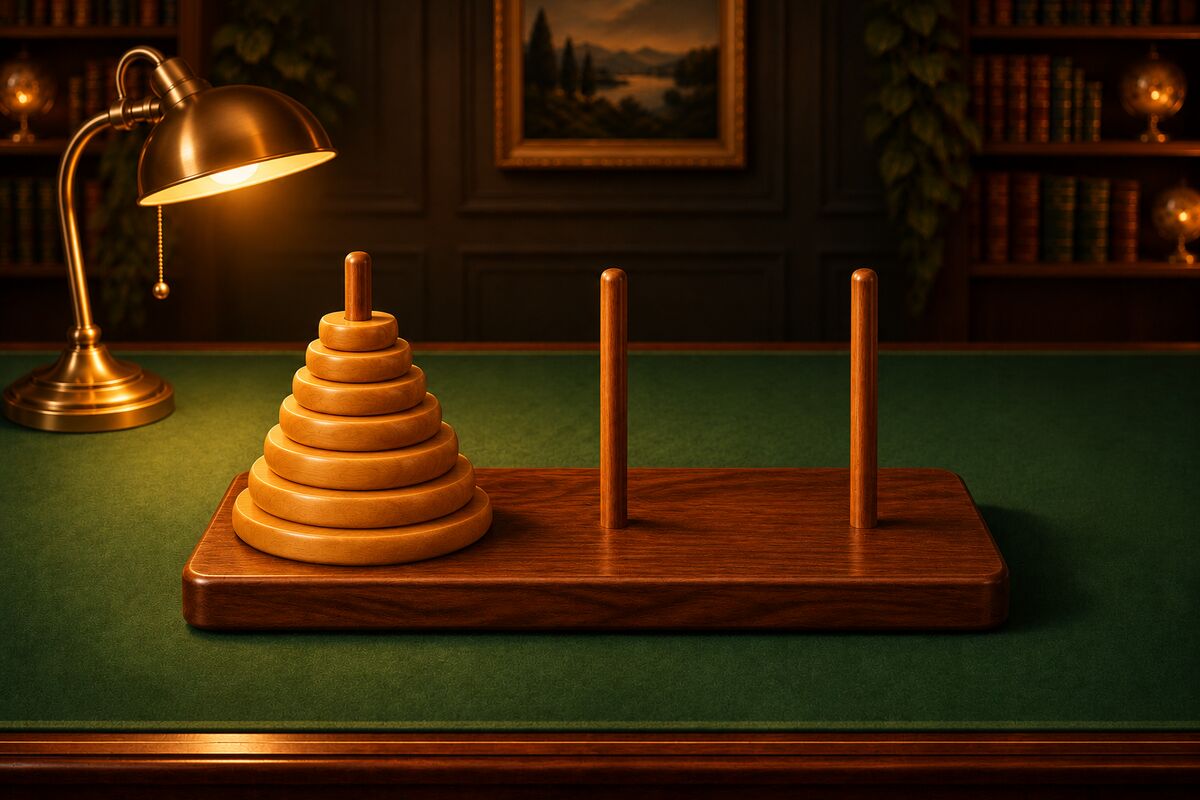
The Tower of Hanoi has only three rules, so even small children can play it. A good thing about it is that by changing the number of disks, everyone from children to adults can enjoy the same set. Here are guidelines and tips for playing with children.
From What Age Can Children Play?
Children are good at different things, so the table below is only a rough guide. Watch whether they are enjoying it, and adjust the number of disks.
| Rough age | How to play | Disks |
|---|---|---|
| Around 3 to 4 | Stack the disks from largest to smallest to make a tower | 3 to 5 disks |
| Around 5 to 6 | Move the tower to another pole, following the rules | 2 to 3 disks |
| Early elementary school (ages 6 to 8) | Try to move it in few moves | 3 to 4 disks |
| Upper elementary (age 8 or older) | Find the rule of the method | 5 disks or more |
Around ages 3 to 4, stacking in order, “large at the bottom, small on top”, is fun in itself, more than moving by the rules. Play by putting the disks onto a pole and comparing sizes.
Do not use small disks or coins with children old enough to put things in their mouths. If you make one by hand, using larger disks is safer (the article on making one).
How to Teach It the First Time
1. Start with 2 Disks
If you go straight to 3 disks, children get lost from the very first move. First, with 2 disks, do these 3 moves together:
- Move the small disk to the middle
- Move the large disk to the right
- Move the small disk to the right
If they understand “to move the large disk, I can just move the small disk above it out of the way”, they have already grasped the important idea of the Tower of Hanoi.
2. One Rule at a Time
It is easier to understand if you tell them the rules one at a time while playing, rather than explaining them all at once.
- “You can move only one disk at a time.”
- “You can move only the top disk.”
- “You can’t put a big disk on a small disk.”
If a child is about to put a large disk on a small one, it can help to use words that are easy to picture, like “if the big one sits on the little one, the little one will get squashed.”
3. Ask Questions Instead of Giving the Answer
When they are stuck, rather than giving the answer right away, try asking questions that prompt them to think.
- “What should we do to move the biggest disk?”
- “Where could we put this small disk so it’s out of the way?”
- “Is there anything similar to when we did 2 disks?”
The joy of figuring it out themselves leads to the next challenge.
4. Count the Moves When They Can Do It
Once they can move it by the rules, try counting the moves. The fewest moves is 7 for 3 disks and 15 for 4 disks. Having a goal like “I did it in fewer than before!” adds to the fun of playing again and again.
Ways to Expand the Play
- Family competition: With the same number of disks, compare who can do it in the fewest moves, or in the fewest seconds.
- Adults get serious too: If you change the number of disks, such as 7 for an adult and 3 for a child, you can compete together.
- For a science project: If you record the moves while adding disks, the rule of the numbers appears (Elementary School Science Project).
- With a story: Some children become interested when you tell the legend that “when the 64 golden disks have all been moved, the world will end” (Origins and Legend).
Try It from 2 Disks
The board below starts with 2 disks. Try adding one disk at a time together with your child. Tap a pole to lift a disk, and tap another pole to put it there.