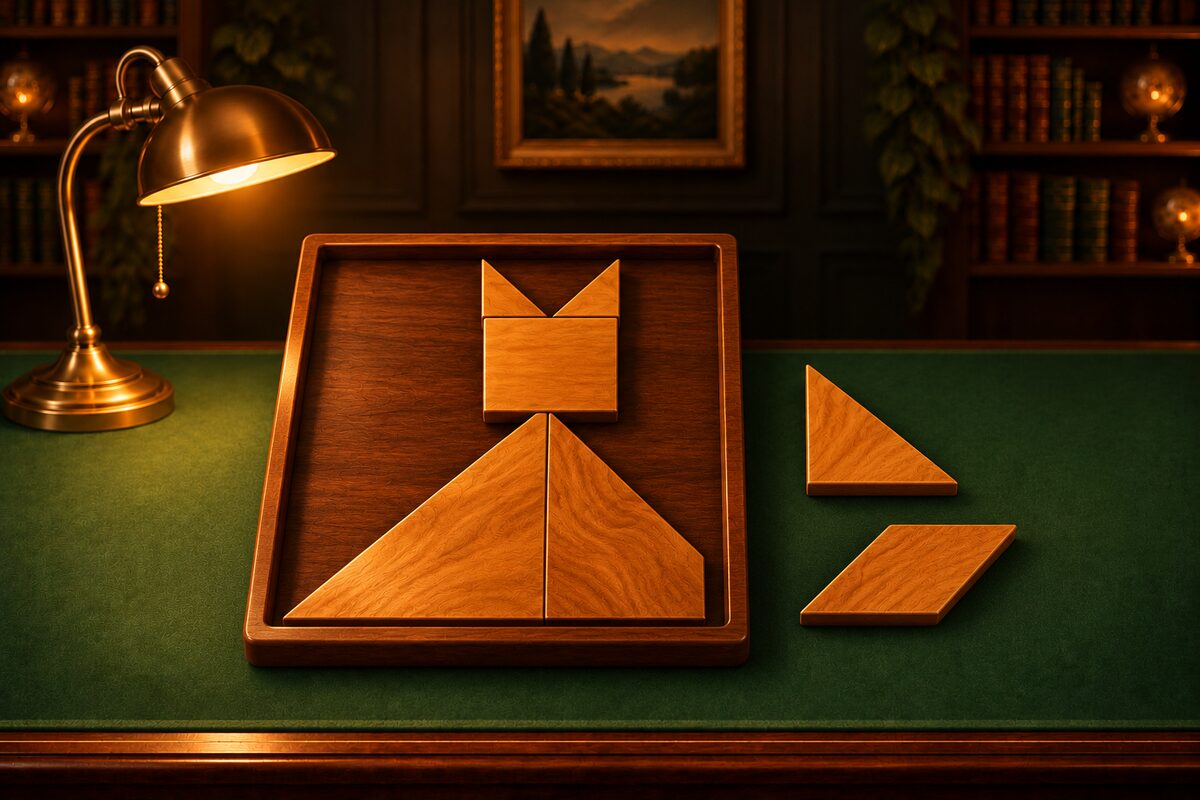
Tangram is a puzzle where you combine seven pieces cut from a single square to make shapes such as animals, people, and tools. It was born in China and has been played around the world. In China, it is called “qiqiaoban.”
The Seven Pieces
The pieces are these seven.
| Piece | Label in the figure | Number |
|---|---|---|
| Large triangle | L | 2 |
| Medium triangle | M | 1 |
| Small triangle | S | 2 |
| Square | Sq | 1 |
| Parallelogram | P | 1 |
Every triangle is a “right isosceles triangle,” with two sides of equal length next to the right angle. They come in three sizes.
The Seven Make One Square
Arrange the seven pieces and they fit back together into exactly one square.
We had a computer check every way of placing the pieces with their sides lined up on the grid of small triangles. Counting arrangements that match after rotating or flipping as the same, there is only one way to make this square.
How the Piece Sizes Relate
If the area of a small triangle is 1, the areas of the other pieces are as follows.
| Piece | Area |
|---|---|
| Small triangle | 1 |
| Medium triangle | 2 |
| Square | 2 |
| Parallelogram | 2 |
| Large triangle | 4 |
| Total of all seven | 16 |
The medium triangle, the square, and the parallelogram have different shapes, but each has the area of two small triangles. If you line up two small triangles, you can make any of these three shapes.
The angles also come in only three sizes across all the pieces: 45°, 90°, and 135°. That is why the sides and corners of the pieces fit together so neatly.
What the Name Means
Where the English name “tangram” came from is not clear. One theory combines the Chinese “Tang” with “gram,” meaning a diagram or writing, but it is said that nothing is known for certain.
The Chinese name “qiqiaoban” means something like “seven boards that call for skill and wit.”
The Basics of Play
Playing is very simple.
- Look at the puzzle shape (a silhouette).
- Arrange all seven pieces without overlapping to make that shape.
- You may rotate the pieces and flip them over.
That is the whole set of rules, but from the same seven pieces you can make countless shapes. Examples of puzzles are in Tangram Puzzles.
For how to play in the Tangram app, see Tangram Rules and How to Play.