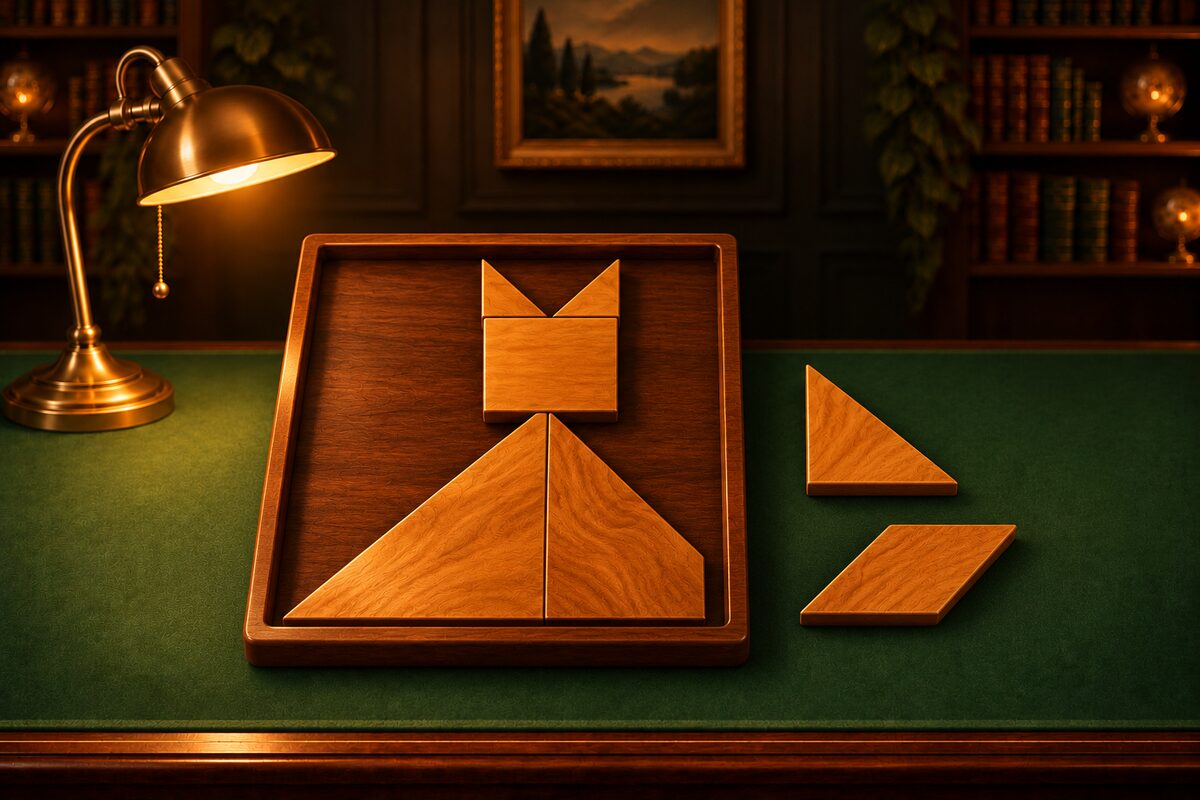
The seven tangram pieces are what you get when you cut one square apart. Try putting the loose pieces back into the original square. It looks easy, but it turns out to be surprisingly tricky.
The Finished Shape
L = large triangle, M = medium triangle, S = small triangle, Sq = square, and P = parallelogram.
Steps for Arranging It
- Place the two large triangles with their right-angle corners pointing at the center of the square. This fills the top and left sides.
- What is left at the lower right is a space shaped like a right isosceles triangle, as big as two large triangles. Put the medium triangle in the right-angle corner (lower right) of that space.
- In the narrow space that remains, line up the parallelogram, small triangle, square, and small triangle, starting from the upper right.
If the parallelogram does not face the right way in step 3, try flipping it.
There Is Only One Arrangement
We had a computer check every way of placing the pieces with their sides lined up on the grid of small triangles. It found 8 arrangements that make the square, but every one was the figure above rotated or flipped. A square lands on itself in 8 orientations by rotating and flipping, so there is really only one different arrangement.
Arrangements that only swap two triangles of the same size (the two large triangles, or the two small triangles) are counted as the same arrangement.
Easier to See Half at a Time
If you cut the finished figure along the diagonal from the upper right to the lower left, the pieces split into two groups: “the two large triangles” and “the other five.” Either group can be rearranged to make a square of the same size.
- The two large triangles can make one small square.
- The other five (the medium triangle, the two small triangles, the square, and the parallelogram) can also make a square of the same size.
If you add up the areas of the five pieces, counting a small triangle as 1, you get 2 + 1 + 1 + 2 + 2 = 8, the same as the two large triangles (4 + 4 = 8). This group of five often appears in other puzzles too, such as the rectangle and the triangle (Tangram Solutions).
However, putting the two small squares side by side only makes a rectangle, not the original square. In the original square, the large triangles and the group of five are split diagonally.
Other Shapes with No Bumps
Shapes with no dents, like the square (convex polygons), are known to number 13 when made with the seven pieces. The 13 shapes are shown in 13 Convex Polygons You Can Make with the Seven Tangram Pieces.