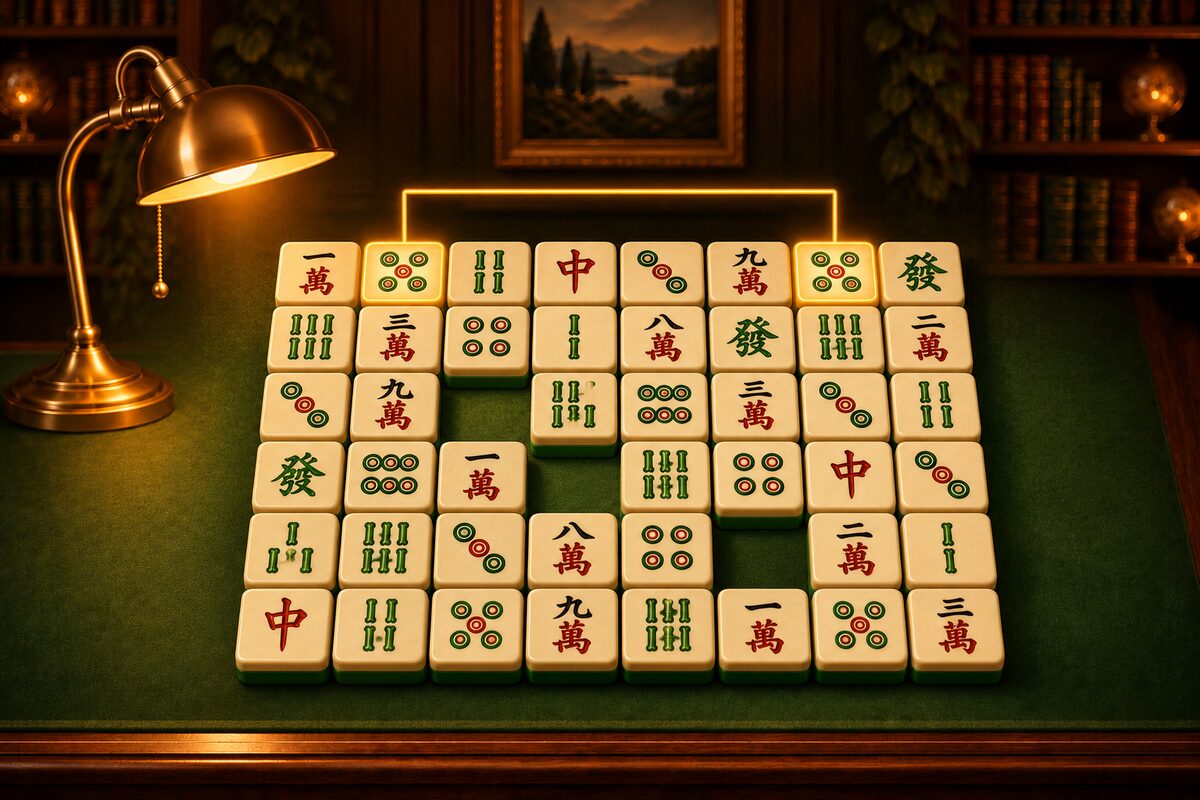
In Shisen-Sho, a line can pass through the one-square border outside the board. In the diagrams, the dotted frame is that outside. How well you use the outside changes a lot how easily you spot pairs you can remove.
Lines Along the Outside Are U-Shaped
A line that goes along the outside takes this shape.
- It goes straight out from the first tile to the outside of the board.
- It runs along the outside, following the edge of the board.
- It goes straight in to the second tile.
It has exactly two turns. So two tiles connect along the outside when both can go straight out to the outside of the same side.
The two 3 of Circles tiles at both ends of the top row can both go out upward, so they connect along the outside at the top.
Inner Tiles Can Use the Outside Too
Even a tile that is not at the edge can use the outside if the column or row leading to it is open. In the diagram below, the White Dragon on the left is in the third row, but the two squares above it are empty, so it can go out to the outside at the top. It connects to the White Dragon in the top row along the outside.
Outsides of Different Sides Do Not Connect
Even if both tiles can go out, they do not connect if they go out on different sides. In the diagram below, the right 1 of Characters can go out to the right, and the left 1 of Characters can go out to the left and bottom. They share no side, so going around the outside would take three or more turns.
Opposite Corners Do Not Connect Along the Outside Alone
Two tiles in opposite corners, such as the top-left and the bottom-right, always need three turns if the line goes only along the outside. The tile in the top-left corner can go out to the top and left, and the tile in the bottom-right corner can go out to the bottom and right. They share no side.
Two tiles in opposite corners cannot be removed until a path opens inside the board. Clear the tiles between them early.
Lines That Do Not Use the Outside
For a line that turns only inside the board, an L shape with one turn has its corner at the square where the rows and columns of the two tiles cross. That square is always inside the board, so an L-shaped line never uses the outside. Only lines with two turns use the outside.
The squares outside are always open, no matter how many tiles you have removed. That is why removing tiles at the edge first creates more paths that use the outside. For how to tell whether a pair can be removed, see How to Tell Whether a Line Connects.