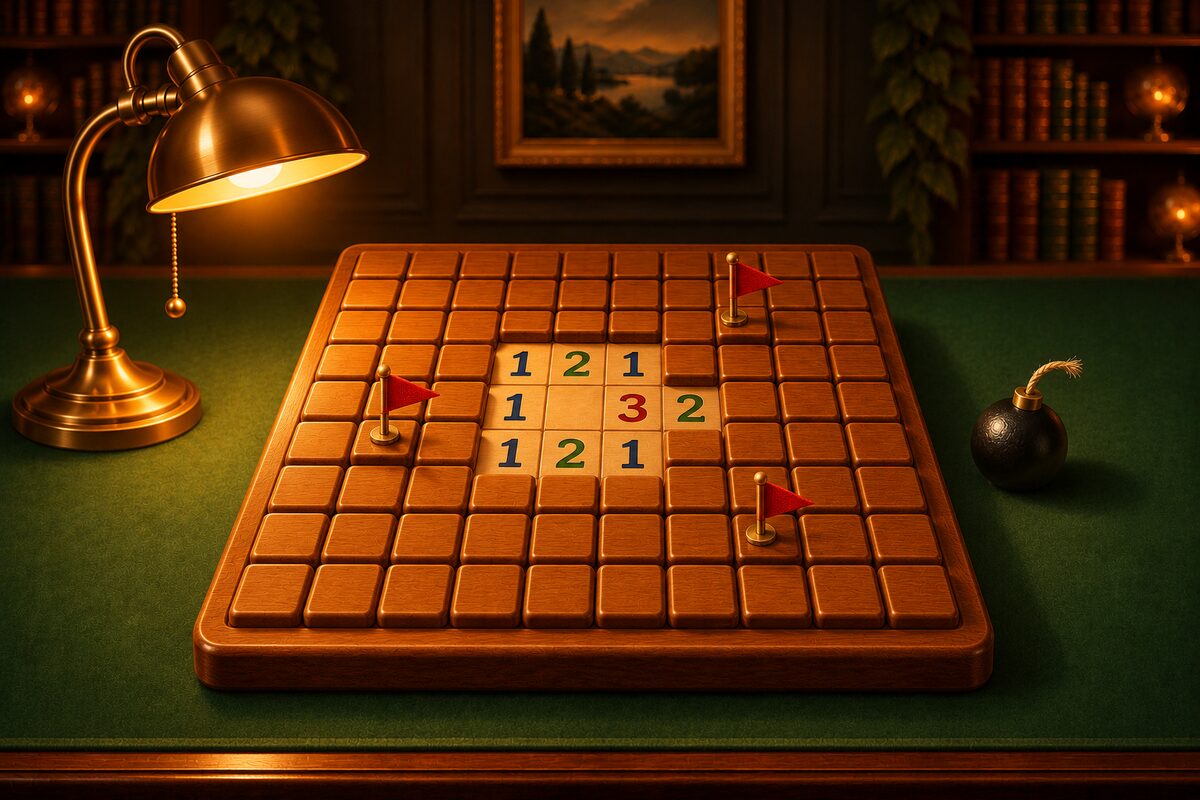
If you have ever used a computer, you may have seen Minesweeper at least once. Here is how it was born and spread, as far as can be confirmed. Some years and names are disputed, so please read the parts that say “is said to” as rough guides.
Mine-Finding Games of the 1980s
Computer games where you move forward while avoiding hidden mines are said to have already existed in the 1980s. For example, there is said to have been a game for home computers in Britain around 1983 where you walked across a minefield.
The idea in games like these of “using the number of mines around you as a clue to find a safe path” is thought to have led to today’s Minesweeper.
Coming with Windows and Spreading Worldwide
The version that made the name “Minesweeper” known around the world was the one in Microsoft Windows. It appeared around 1990 in a collection of extra games, and from Windows 3.1, around 1992, it is said to have come with Windows from the start.
You could play it as soon as you bought a computer, so more people played it between work or study, and Minesweeper became the best-known “game that comes with the computer.” The form we know today, with a grid board, numbers, flags, and mines, became widely known through this Windows version.
How the Look Changed
In later versions of Windows, Minesweeper stayed for a long time. Some versions are said to have had a new look, or a look where you search for flowers instead of mines.
Eventually, it is said to have become an app that you get from the store instead of coming with Windows.
The Era of Phones and Browsers
Today, you can play Minesweeper not only on a computer but also in phone apps and in a browser. To suit tapping the screen, ideas such as “long press for a flag” and “switching between flag and dig” appeared.
No-guess boards also began to be made, getting rid of the “50/50 that logic cannot settle” that ordinary Minesweeper could not avoid. This became possible because computers can check whether a board is solvable by logic when they build it (How No-Guess Boards Are Made).
A Topic in Math, Too
Minesweeper has also been taken up in math and computer science research. The problem of checking mine layouts is said to have been shown to belong to a family of hard problems called “NP-complete” (Minesweeper and Math).
The Minesweeper App
The Minesweeper app was released for Android in November 2026. It has the look of a wooden board game, with walnut tiles and an ivory board, and every board can be solved by logic alone from the first square. It keeps the classic rules as they are, and with Hint and Undo, it lets you enjoy logic all the way to the end.