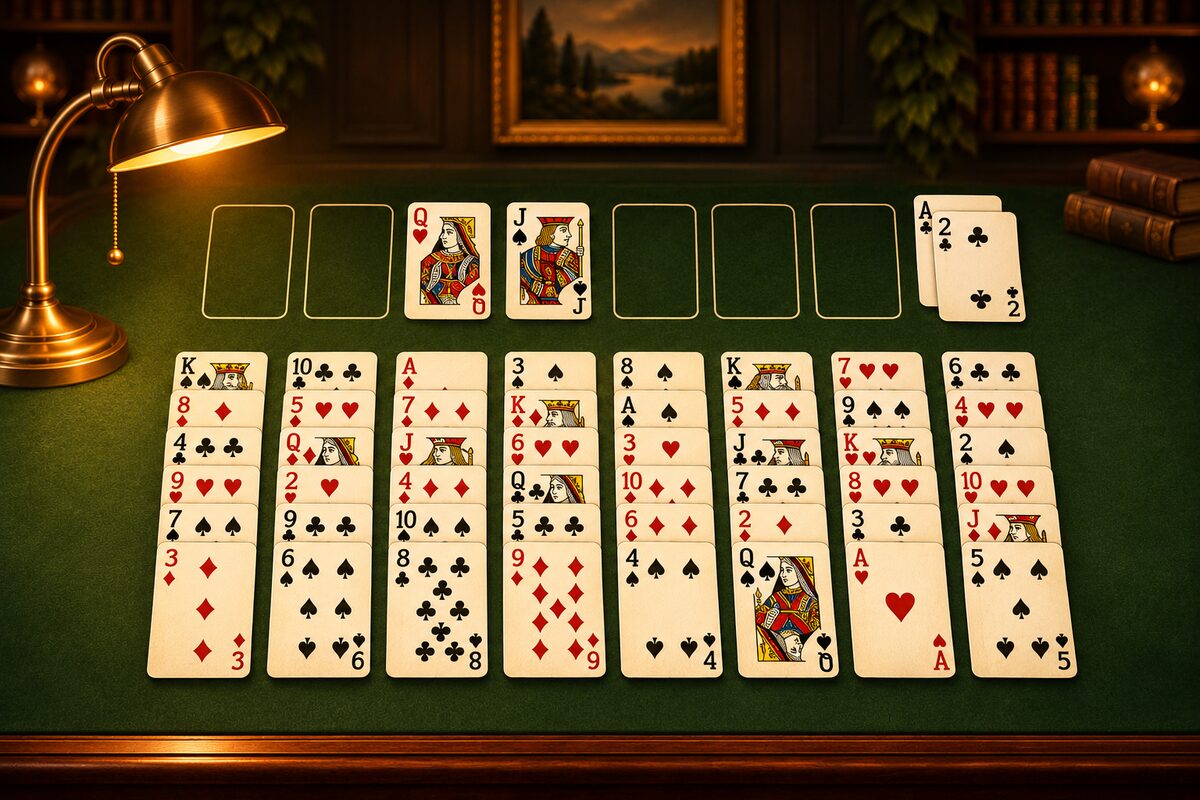
FreeCell is a relatively new game among card solitaires. This article traces its history. Some of the early history is unclear, so we separate what is certain from what is only told.
A Very Similar Game: Baker’s Game
A solitaire game very similar to FreeCell is “Baker’s Game.” You deal 52 cards face up into eight columns and build them up onto the foundations, using four empty spaces to help.
The big difference from FreeCell is how cards are stacked in the tableau. In Baker’s Game, you stack cards of the same suit, one number lower each time. In FreeCell, you stack alternating red and black. Because there are more cards you can stack on, FreeCell is easier (FreeCell Variants).
Born as a Computer Game
FreeCell is said to have been created by Paul Alfille in the United States in 1978, as a game made on “PLATO,” an educational computer system used at universities and elsewhere. It changed the stacking rule of Baker’s Game to alternating red and black.
Most card solitaires are old games that people played on tables. FreeCell has a somewhat unusual background: it spread as a game meant to be played on a computer from the start.
To the World with Windows
FreeCell is said to have become known around the world largely because it came with Microsoft Windows. The Windows version, made by Microsoft employee Jim Horne, went through a Windows game collection and then came built in to Windows 95 in 1995.
In Windows FreeCell, the deals were given numbers from 1 to 32,000, and you could choose a number to play. The story is well known that when many people on the internet divided up the work of solving those 32,000 deals, they found that only deal number 11982 can’t be solved (Almost Every FreeCell Deal Can Be Solved).
Later, from Windows 8, it became one of the games in the “Microsoft Solitaire Collection,” which bundles several solitaire games (How the App Differs from Windows FreeCell).
Into the Smartphone Era
Today you can also play FreeCell in a smartphone app. The FreeCell app doesn’t use numbered deals like Windows. It shuffles the cards fresh every time. We checked 100,000 random deals, and every one of them had a solution.
The history of card solitaire itself is covered in The History of Solitaire. The rules of FreeCell are collected in FreeCell Rules and How to Play.