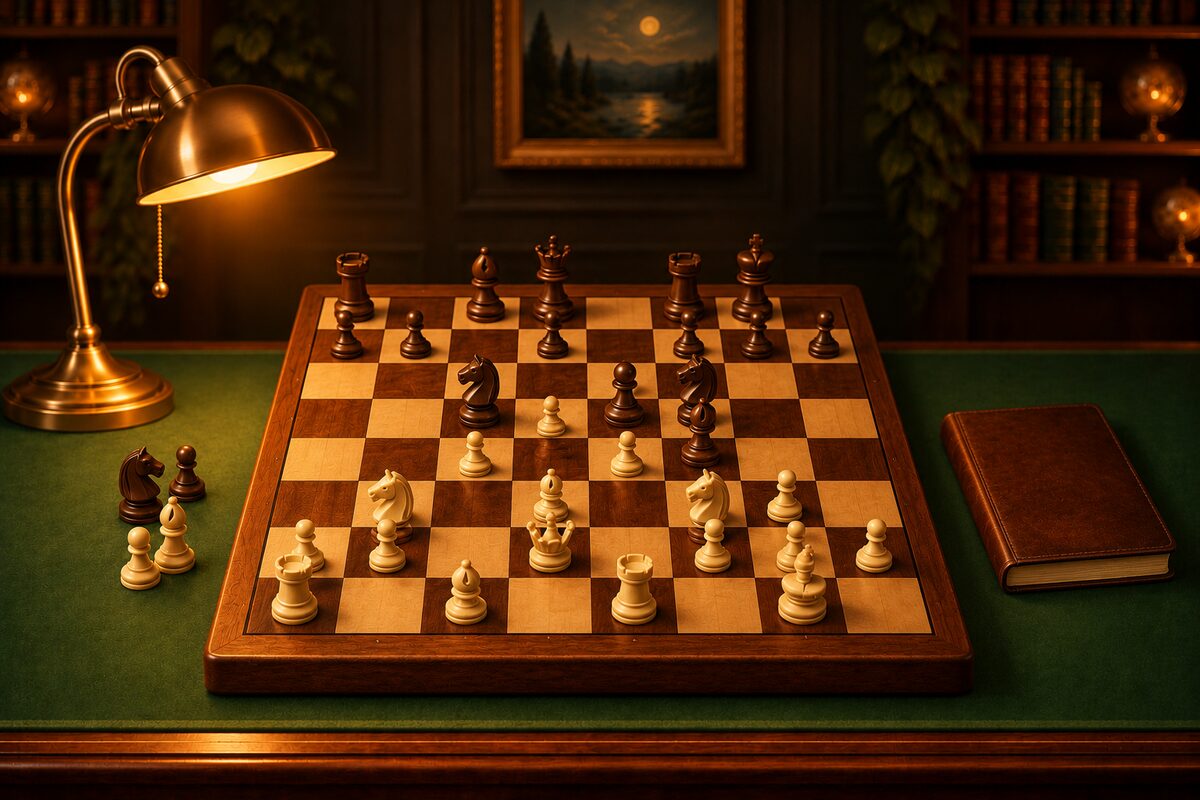
All you need to play chess is a board and 32 pieces. Playing with a real board and pieces lets you enjoy the feel and the sound, too. This article covers what to look for when choosing a chess board and chess set. It doesn’t recommend any particular product. It just lays out how to think about the choice.
Board Basics
A chess board has 64 squares, 8 across and 8 down, with light and dark squares alternating. The colors don’t have to be white and black. Light and dark wood, or cream and green, are fine as long as the two colors are clearly different.
When you set it up, turn the board so that the lower right corner, as seen by each player, is a light square (How to Set Up a Chess Board).
Choosing by Material
- Wood: The classic choice. It feels good in the hand, and the sound of the pieces being set down is pleasant. It is heavy and stable. Prices vary widely.
- Plastic: Light and durable, and often easy on the budget. A good fit for playing with kids or for buying several sets.
- Roll-up boards: Vinyl or cloth boards can be rolled up and carried in a tube. Chess clubs and classes often use them.
- Folding boards: Some boards fold into a box that also stores the pieces.
Matching the Sizes
The board and the pieces need to be in proportion.
- Squares and piece bases: As a rule of thumb, the widest base of a piece should fit inside a square with some room to spare. If pieces overhang the squares, they bump into their neighbors and become awkward to move.
- Tournament guideline: Tournament boards are said to have squares about 5 to 6 cm (2 to 2.4 in) on a side, with a king about 9.5 cm (3.7 in) tall.
- For playing at home: Fit the board to your table. A slightly smaller board is plenty. For small children, pieces that are easy to hold in a hand are a good choice.
Piece Style
Tournaments and classes most often use the “Staunton” style, which spread in 19th-century England. Its shapes are clear and easy to tell apart: the cross on the king’s head, the queen’s crown, the rook’s tower, the bishop’s pointed head, and the knight’s horse head.
Elaborate, ornamental pieces are fun to look at, but it can be hard to tell which piece is which. For a first set, we recommend pieces with easy-to-recognize shapes.
Handy Extras
- A board with coordinates: If the edges are marked a to h and 1 to 8, reading and writing game records is easier (How to Read Chess Notation).
- A spare queen: When a pawn promotes, you can sometimes need two queens (Pawn Promotion).
- Magnetic sets: Pieces that stick to the board with magnets let you play in places that shake, such as on a train or in a car.
When You Don’t Have a Board
If you have no board and pieces, you can still play by drawing a grid on paper and placing slips of paper with the piece names on them. You can also use a smartphone or tablet as your board. The Chess Board app is a chess board app for two people to play around one device, and Dress Up lets you change how the pieces and board look (Changing the Look of Your Board and Pieces).