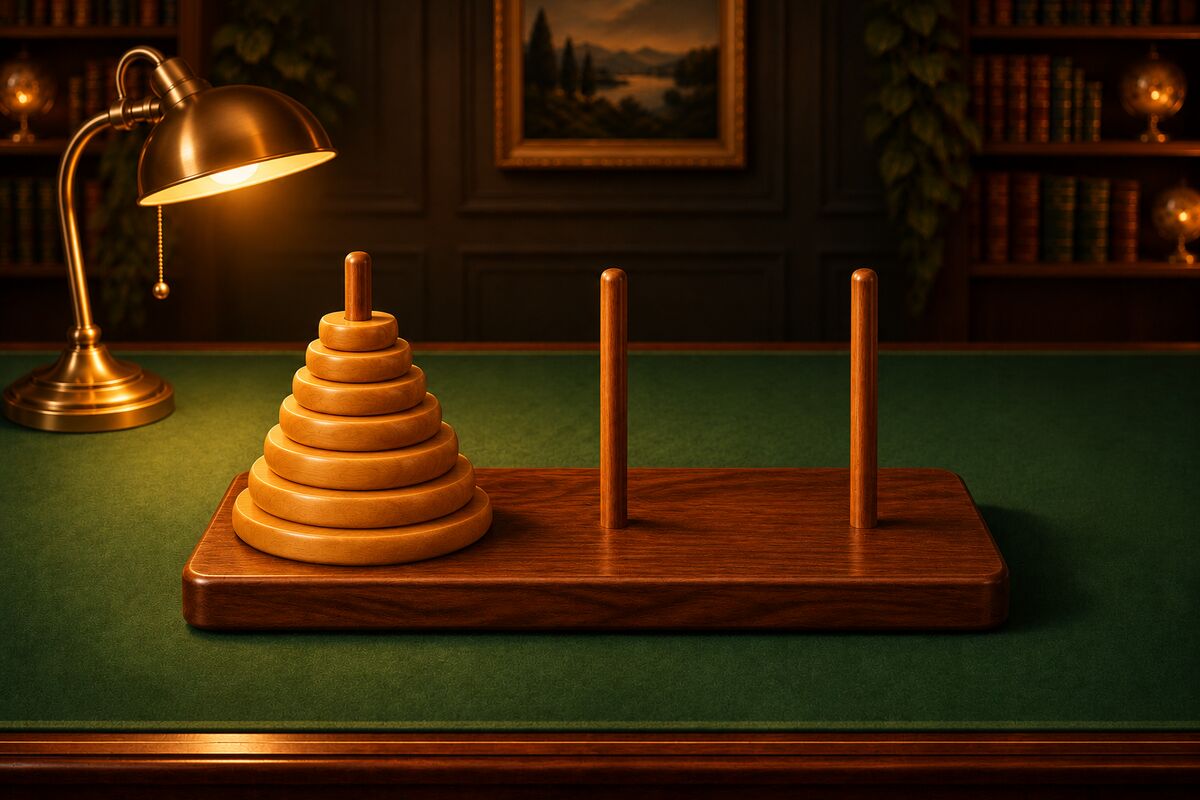
In the Tower of Hanoi app’s Color Sort mode, you finish when the disks of three colors, red, blue and gold, are sorted one color per pole. You can choose it under “Mode” in Settings. The rules are the same (move one disk at a time, and never put a large disk on a small one), and all the disks are different sizes. In this article the disks are numbered 1, 2, 3… from smallest to largest.
The Rules of Color Sort Mode
- The disks come in three colors, red, blue and gold, with about the same number of each.
- You can gather any color on any pole. There are 6 possible finished shapes, from the combinations of colors and poles.
- The difficulty has the same 5 levels as Puzzles mode, with disks from 5 at 1 star to 9 at 5 stars.
- In the box at the top of the screen, the finished shape that is closest to the start, out of the 6, is drawn as the “Example”.
First, Decide “Which Color Goes on Which Pole”
The most important thing in Color Sort is to decide which color to gather on which pole before you start moving. Once you have decided, you just carry the large disks to their destinations first, as in Puzzles mode (Puzzles mode guide).
Here are three rules of thumb for deciding.
- The larger the disk, the more moves it takes to move: To move a large disk, you have to clear away the disks above it and the disks on the destination pole. A pole that already has a large disk is often a good destination for that color.
- Small disks are cheap to carry anywhere: The smallest disk can go to any pole in one move. A color made up of only small disks is fine even if you fit its destination in later.
- When in doubt, look at the “Example”: The example in the top box is the closest of the 6 shapes. If you aim for that shape, you get the assignment with the fewest moves.
The Trap: Gathering on the Pole with the Biggest Disk Makes a Detour
The first idea that comes to mind is “gather each color on the pole that has that color’s biggest disk.” But at 3 stars about half of the puzzles, and at 4 and 5 stars every puzzle, include a case where this approach makes a detour.
Let’s look at a small example. With 5 disks, 1 is gold, 2 and 3 are red, and 4 and 5 are blue.
- Start
- Straightforward finished shape (12 moves)
- Closest finished shape (7 moves)
The biggest disk of each color is red 3 on the right, blue 5 in the middle, and gold 1 on the left. If you go with the obvious choice, “red on the right, blue in the middle, gold on the left”, it takes 12 moves even at best. On the right pole, blue 4 is under red 3. To gather red on the right, you first have to move 3 aside and carry 4 to the middle, and to do that you also have to move red 2 in the middle out of the way. You send both red disks away once and then bring them back, which is double work.
But if you decide “red on the left, blue in the middle, gold on the right”, you finish in 7 moves.
- Start
- Move 1 1 to the middle
- Move 2 3 to the left
- Move 3 1 to the right
- Move 4 2 to the left
- Move 5 1 to the left
- Move 6 4 to the middle
- Move 7 1 to the right
Gold is only the small disk 1, so it is cheap to carry anywhere. So we gather red on the left, where it is easy to clear, and put gold on the right at the end. The tip is not to stick to “the pole with the biggest disk”, but to decide the destination of the disk that is hard to move (here, blue 5 in the middle) first, and choose the easier destinations for the other colors.
Noticing the Trap
Once you have decided on an assignment, check the following before you start moving.
- Is there a large disk of another color on the destination pole? If there is, it takes moves to clear it away.
- To gather one color, are you having to clear away a pile of another color’s disks and then put it back, double work?
If either applies, also think about a shape where the destinations of the colors are swapped. You do not need to think through all 6 cases. Often you can find it just by fixing the destination of the large disk’s color and swapping the other two colors.
Hint and the “Example”
If you get stuck, press “Hint” to see the next move toward sorting in the fewest moves. In Color Sort too, it gives an answer from any arrangement. You start with 3 hints, and when you use them up, you can watch an ad to get 3 more.
The “Example” in the top box becomes larger when you tap it, and the disks show their numbers. When you are unsure about the assignment, start by looking closely at the example and checking which color goes to which pole.