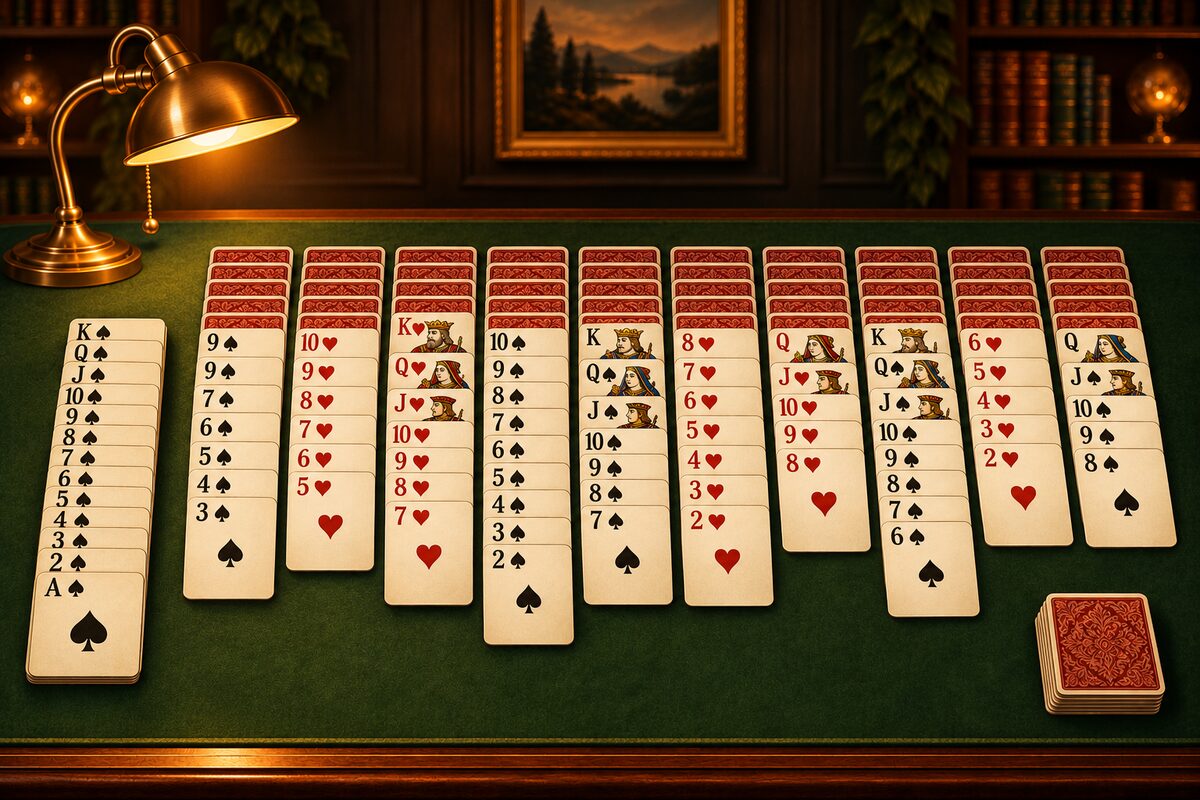
In Spider Solitaire, when a column empties, any card can go there. In Solitaire (Klondike) only a King can go in an empty column, but in Spider anything can, so an empty column is the most useful workspace. Here is how to use it.
Use 1: carry a broken run
The only cards you can move together are a same-suit run. A run broken by mixed suits can’t be carried as it is. But with one empty column, you can carry it.
You want to carry the 9 of hearts, 8 of spades and 7 of spades in column 1 onto the 10 of hearts in column 2. The 9 of hearts and the 8 of spades are different suits, so you can’t move all 3 cards together. So you use the empty column 3.
- Move the 8 and 7 of spades to the empty column 3.
- Move the 9 of hearts onto the 10 of hearts in column 2. The face-down card in column 1 turns face up.
- Move the 8 and 7 of spades from column 3 onto the 9 of hearts in column 2.
Now all 3 cards are carried to column 2, and column 3 is empty again.
The more empty columns, the longer the run you can carry
If you count one same-suit run as “1 piece”, the number of empty columns and the number of pieces you can carry at once are as follows. We checked the number of pieces you can carry without using any other column with a program that tries every way of moving.
| Empty columns | Pieces you can carry |
|---|---|
| 0 | 1 |
| 1 | 2 |
| 2 | 4 |
| 3 | 8 |
Each additional empty column doubles the number of pieces you can carry. If you hold two empty columns, you can move quite freely.
Use 2: rebuild stacks of mixed suits
You can use an empty column as a temporary spot to rebuild two columns that ended up stacked in mixed suits into same-suit ones. The steps are shown in a diagram in Normal (2 suits): how to solve it and tips.
Use 3: move a King that blocks face-down cards
Nothing can go on top of a K, so a K sitting on face-down cards can’t move until you have an empty column. Once you have one, move that K (together with the run that continues from it) and you can turn the face-down cards below face up. The best place for a K is the very back of the empty column.
Don’t just leave a card in an empty column
Once you put a card in an empty column, it goes back to being an ordinary column. If you choose moves that leave the column empty again after you use it, as in Uses 1 and 2, you can use it as a workspace again and again. When you have no choice but to put something there, choose something you won’t regret later, such as
- a run that starts with a K (you don’t need to move it any more)
- a long same-suit run (you can move it together later)
Putting in a single odd card blocks your workspace.
When you deal the stock, fill the empty column
You can’t deal the stock while there is an empty column. When you want to deal, first put something in the empty column. Choose what to put there with the same thinking as “Don’t just leave a card” above (When to deal the stock).
Which column should you go for?
- A column with few face-down cards: at the start, the right 6 columns have 4 face-down cards and the left 4 columns have 5 (Setup).
- A column already gathered in one suit: if you move it together, you can empty it in one go.
- A column about to complete 13 cards: when the run is complete and cleared, the column empties if nothing is under it.
More tips are collected in Spider Solitaire tips.