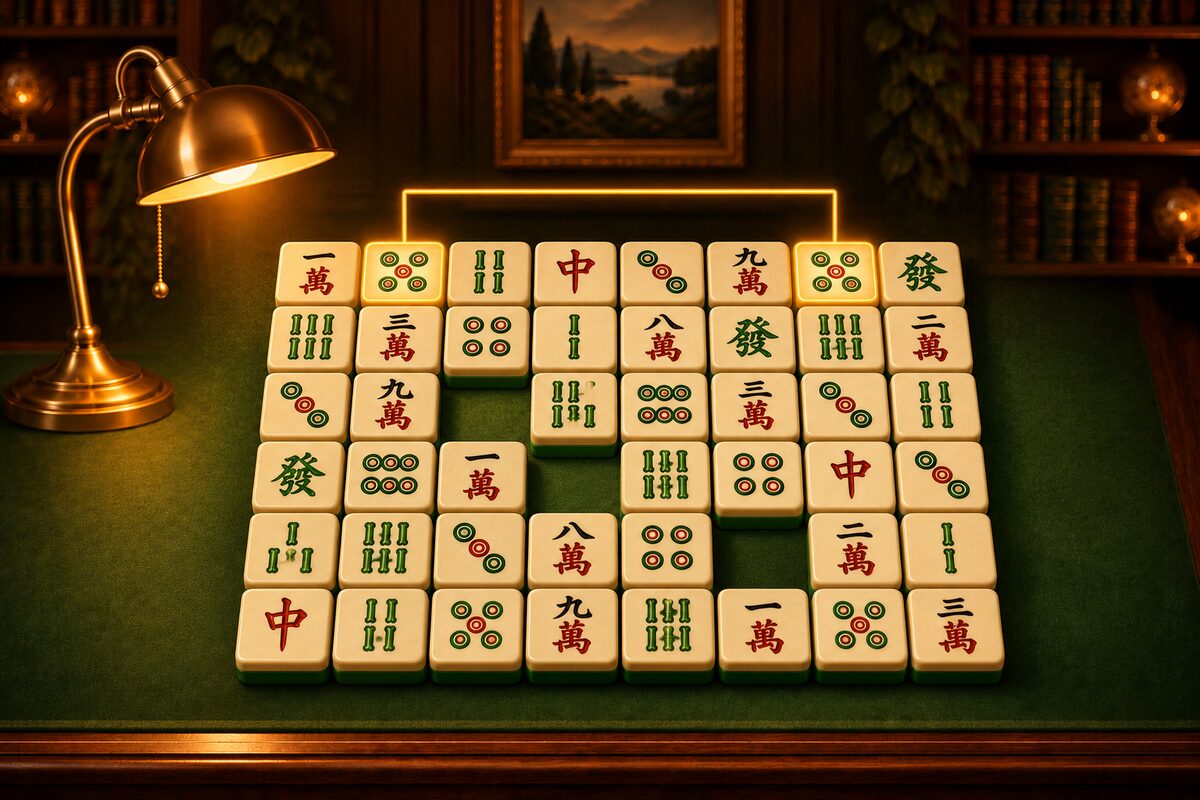
Nikaku-tori, also called Shisen-Sho, is a solo puzzle played with mahjong tiles. You can play it without knowing the rules of mahjong. The only rule is “if you can link two tiles with the same picture by a line, you can remove them.” This article checks the rules about that “line” with diagrams.
Four Rules
- When you pick two tiles with the same picture, you may be able to remove them.
- The line connecting them goes only up, down, left, and right.
- The line cannot pass over other tiles.
- The line can have at most two turns. The line can also pass outside the board.
You clear the game when you remove all the tiles. The name “Nikaku-tori” (literally “two-corner removal”) comes from this rule of “at most two corners.”
In the diagrams below, the tiles are drawn with characters. The dotted frame is the one-square border outside the board where lines can pass.
0 Turns: Straight
If nothing is between the two tiles, you can remove them with a straight line. Two tiles next to each other are also connected by a straight line (of length 1), so you can remove them.
1 Turn: L Shape
This is a line that turns once, from vertical to horizontal or the other way around. The square at the corner must be open.
2 Turns: U Shape and Z Shape
A line with two turns comes in two shapes: a U shape (go out, then come back) and a Z shape (shift to another step).
This is an example of a U shape that goes along the outside of the board. The two tiles at both ends of the top row have tiles between them, so a straight line will not work, but if the line goes outside the board, they connect with two turns.
This is an example of a Z shape that passes through an open column.
Examples That Do Not Connect
Even with the same picture, you cannot remove two tiles in cases like these.
- The two tiles are surrounded by other tiles.
- A line can be drawn, but it needs three or more turns to reach.
Neither of the two pairs in the diagram below (the red crosses) connects. The 1 of Bamboo tiles at the top left and the bottom right are in opposite corners of the board. Even going around the outside, a line needs three turns to reach. The two 9 of Bamboo tiles in the middle are surrounded by other tiles.
Two tiles in opposite corners, no matter how open the board is, need three turns if the line goes only along the outside. Wait until the tiles between them are removed and a path opens inside the board.
The Order of Removal Opens Paths
When you remove a tile, its square becomes empty, and lines can pass through it. A pair you could not remove at first becomes removable when you clear the tiles around it. Thinking about which pair to remove first is the fun of Nikaku-tori. For how to think about the order, see Shisen-Sho Tips.
Rules in the Shisen-Sho App
The board in the Shisen-Sho app (Android) has 6 columns by 8 rows with 48 tiles. There are 12 kinds of tiles with 4 of each, and the kinds change from game to game. Lines can also pass through the one-square border outside the board. Every deal is arranged so that you can always remove all the tiles. When no pairs are left to remove, you can use Shuffle to rearrange the tiles into a layout you can clear.
For how to use the buttons, see How to Play Shisen-Sho.