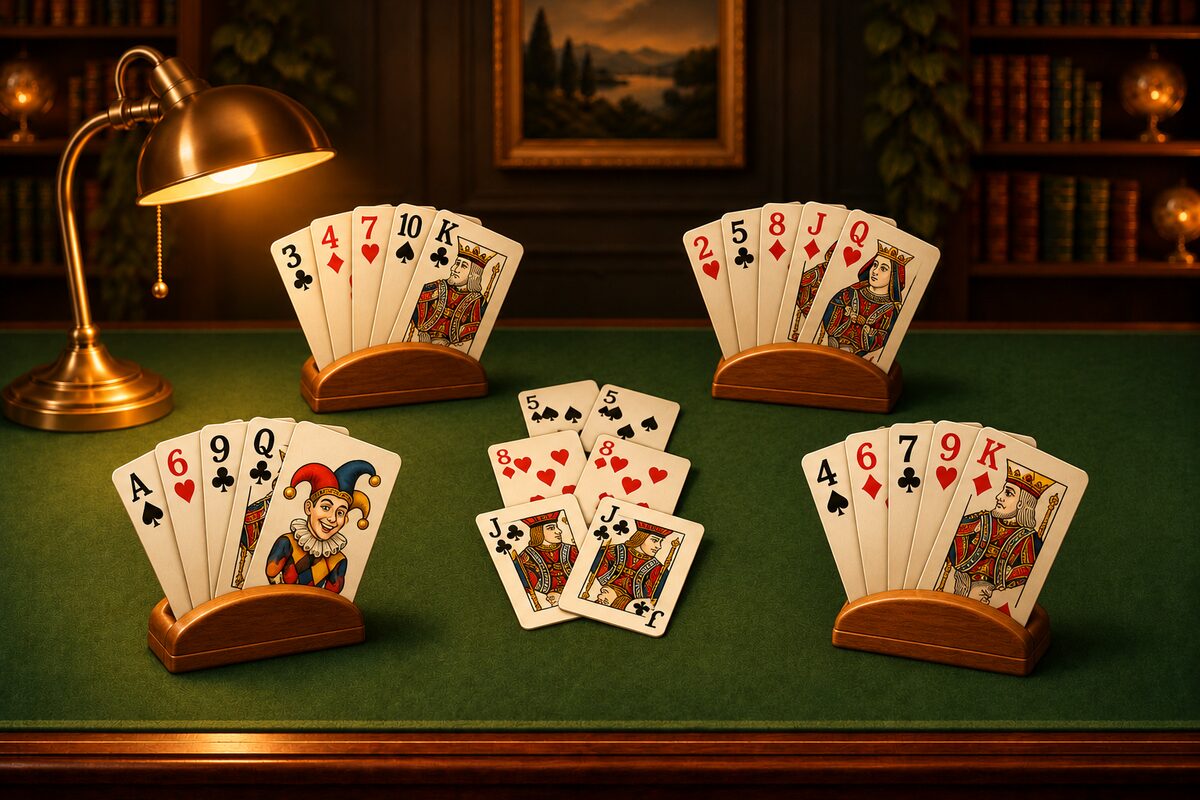
Old Maid is a game of luck, so you might think everyone is about equally likely to end up with the Joker. But when we worked it out, there was a big difference by seat.
How We Calculated It
We played 200,000 games on a computer under the same rules as the Old Maid app.
- The 53 cards are dealt one at a time in the order you, Leo, Rose, Oscar. Only you get 14 cards, and the other three get 13.
- After everyone has discarded their first pairs, play starts with you. The turn order is you, Leo, Rose, Oscar, and each player draws one card from the hand of the player before them. You draw from Oscar.
- Everyone draws at random from the other player’s hand. The computer players in the app draw at random, and when you draw, the other player’s hand comes out shuffled and face down, so it works out the same.
Results
| Seat | Has it at first | Finishes first | Left with it at the end |
|---|---|---|---|
| You | 26% | 39% | 16% |
| Leo | 25% | 9% | 29% |
| Rose | 25% | 9% | 39% |
| Oscar | 24% | 43% | 16% |
“Has it at first” is how often a player is holding the Joker after discarding pairs, and “Left with it at the end” is how often a player is holding the Joker when the game ends.
The share who hold the Joker at first is almost the same for everyone, as you would expect from the number of cards dealt (you have 14 cards, so 14 out of 53 is about 26%). But the share who are left with it at the end is about 16% for you and Oscar, about 29% for Leo, and about 39% for Rose, a difference of more than double. The player who finishes first is also almost always you or Oscar.
The Reason: Even and Odd Hand Sizes
This difference can be explained by whether the number of cards in a hand is even or odd.
Drawing or Being Drawn From Swaps Even and Odd
- You draw and don’t make a pair: Your hand grows by 1 card.
- You draw and make a pair: You gain 1 card and discard 2, so your hand shrinks by 1 card.
- Someone draws from you: Your hand shrinks by 1 card.
In every case, your hand grows or shrinks by exactly one card, so even and odd swap.
After One Round, It Goes Back
During one round, in which each of the four players draws once, everyone draws once and is drawn from once. Even and odd swap twice, so whether a hand is even or odd at the start of a round never changes.
Discarding your first pairs only removes two cards at a time, so even and odd stay as they were when the cards were dealt. So,
- You (14 cards) always have an even number of cards at the start of a round.
- Leo, Rose, and Oscar (13 cards) always have an odd number.
The Way You Can Finish Is Decided by Your Seat
Within a round, which comes first, drawing or being drawn from, is also decided by your seat.
- You: You draw first, and later Leo draws from you.
- Leo and Rose: They draw first, and later the next player draws from them.
- Oscar: You draw from him first, and later he draws from Rose.
A hand can reach 0 cards (even) and finish only after the first of the two events if the player has an odd number, or after the second if the player has an even number. That decides how each player finishes.
- Oscar (odd, drawn from first): He finishes when you draw his last card. If he reaches a round with 1 card, he is sure to finish.
- You (even, the second event is being drawn from): With 2 cards, you draw and make a pair, and then Leo draws your last card, so you finish.
- Leo and Rose (odd, drawing comes first): They can’t finish unless they draw a card with the same number as their last card and make a pair. Even when they are down to 1 card, if the card they draw has a different number, they are back to 2 cards.
We counted 100,000 games for who finished first while all four players were still in. You and Oscar always finished by being drawn from, and Leo and Rose always finished by drawing and making a pair. The seats that finish just by having their last card drawn have a much easier time finishing. Players who finish easily are also less likely to end the game holding the Joker.
Why Rose is more likely than Leo to be left with the Joker also depends on how the turn order changes after someone finishes, so we only give the numbers here.
If the Player with 14 Cards Changes, the Results Change
We worked it out the same way while changing who is dealt 14 cards (you always start).
| Player with 14 cards | You | Leo | Rose | Oscar |
|---|---|---|---|---|
| You | 16% | 29% | 39% | 16% |
| Leo | 35% | 16% | 35% | 14% |
| Rose | 28% | 39% | 18% | 16% |
| Oscar | 25% | 26% | 25% | 24% |
The numbers are the share of games where each player is left with the Joker. When Oscar (the player you draw from first) gets the 14 cards, the shares come out almost even at 25% for everyone. In that case, Oscar also has the “can’t finish unless you draw and make a pair” form, so all four players are under the same conditions.
When You Play in the App
In the Old Maid app, you are dealt 14 cards, and you start. As the calculation above shows, your seat is one where you are less likely to be left with the Joker. Even so, when you are left with the Joker, Pippo the jester celebrates, and you get the most coins.
When you play with real people, the way even and odd decide how seats finish works the same if the turn order and the deal are the same. But people read expressions and try different places for the Joker, so the shares may differ from when everyone draws at random. Probability is also covered in Old Maid Probability.